
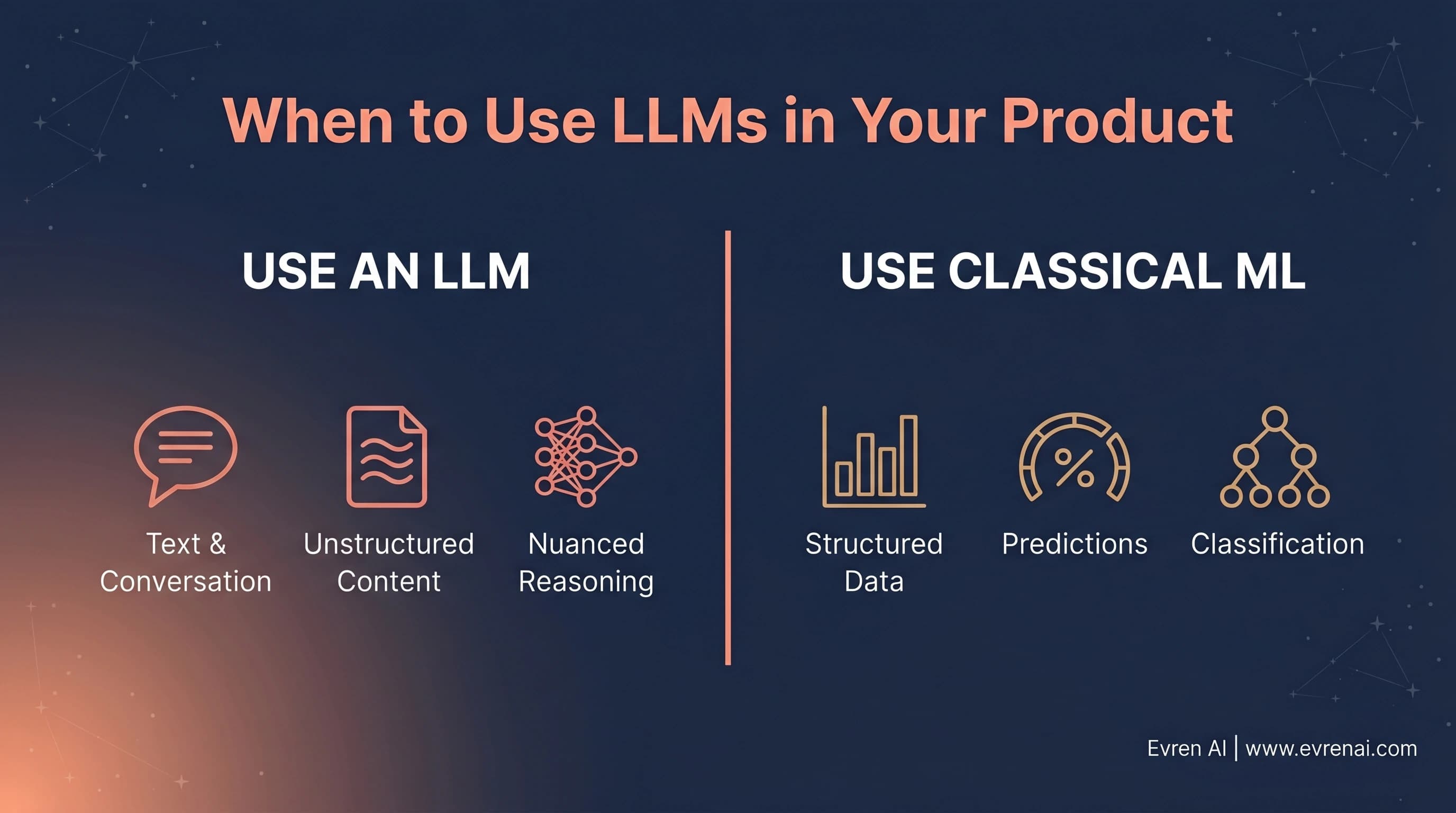
You have budget for AI. Your team is ready to build. What no one has answered yet is the question that will determine everything: does your specific problem actually require a large language model?
Get this wrong in either direction and the cost is significant. We have seen teams spend four months integrating GPT-4 into products where a decision tree would have performed better. We have also seen teams avoid LLMs entirely for text problems that genuinely needed them, ship something fragile, and rebuild at twice the original cost.
Here is the four-question framework we use at Evren AI before recommending a single line of LLM code.
What Signals That a Product Problem Needs an LLM?
A product problem genuinely needs an LLM when the core value your users expect requires understanding, generating, or transforming natural language in ways that rules or structured data models cannot replicate. If the output must handle variation, reason across unstructured text, or respond contextually to free-form input, an LLM is your architecture. If the value is a number, a category, or a rule-based decision, a lighter model will outperform it.
The Four Questions That Decide
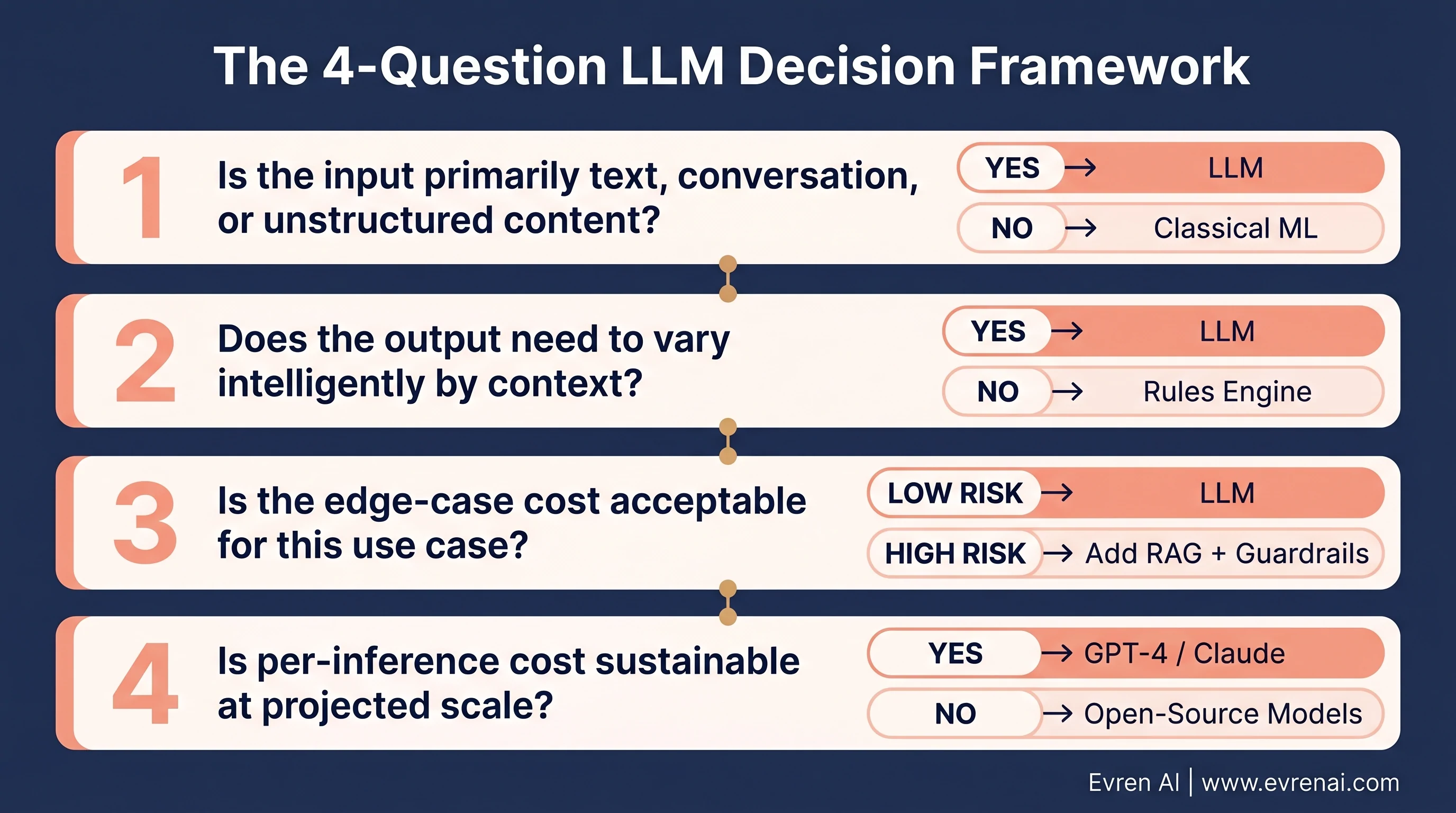
Before recommending LLM architecture to any client, we work through four questions in order. Each one can eliminate the need for an LLM entirely. Most problems only need to fail one question to change the answer.
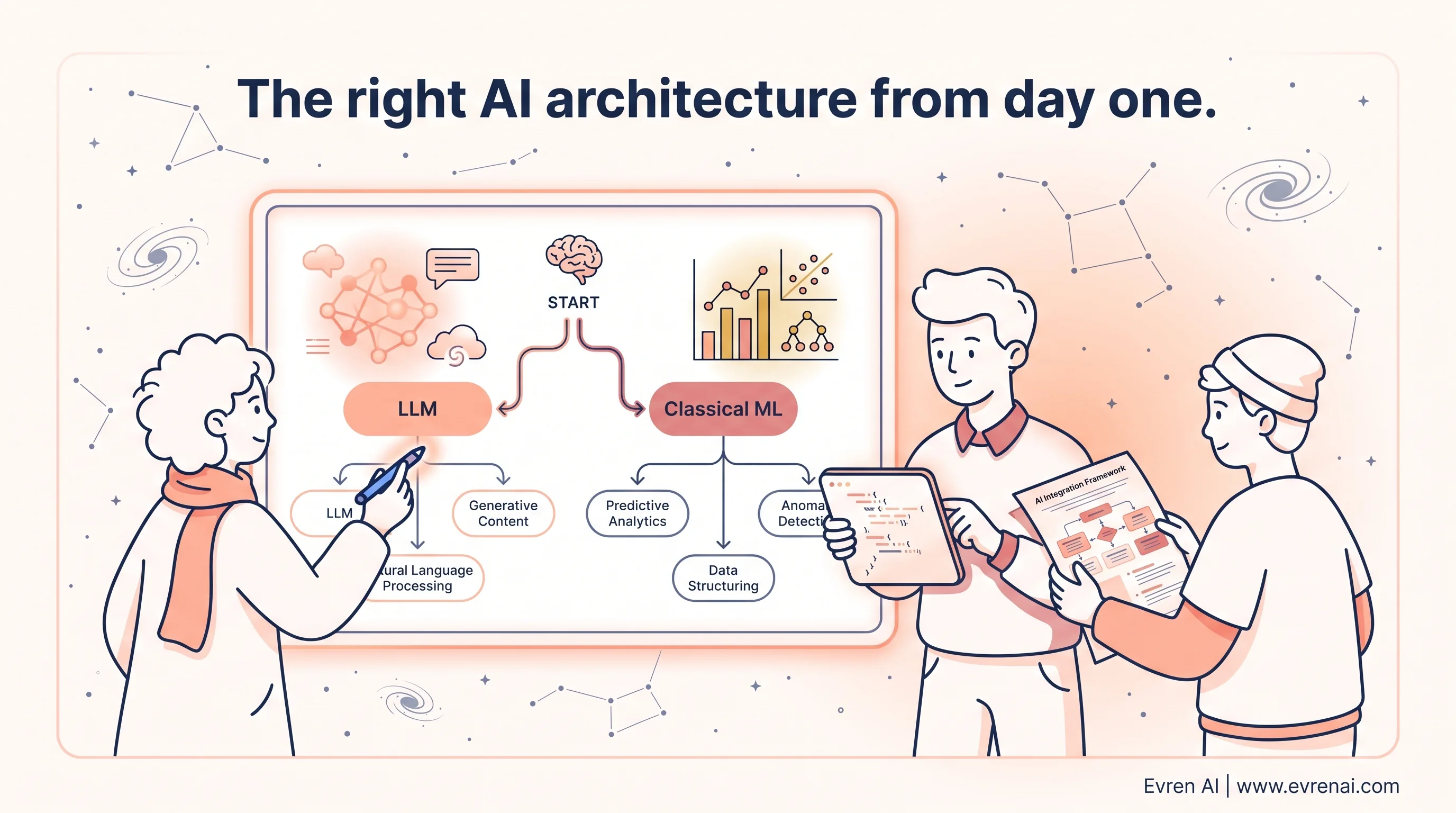
Question one: Is the input primarily text, conversation, or unstructured content? Chatbots, document analyzers, contract reviewers, and content generators belong here. Fraud scoring, demand forecasting, and inventory optimization do not. If yes to text: explore LLM integration. If no: evaluate classical ML before committing.
Question two: Does the output need to vary intelligently based on context? A customer support bot responding differently to an enterprise SLA breach versus a routine billing question needs an LLM. A model returning a churn probability score does not. If the answer is the same every time given the same input type, an LLM is likely overkill.
Question three: Is the edge-case cost acceptable for this use case? LLMs produce unexpected outputs. In a creative writing tool, an off-answer is a minor inconvenience. In a medical documentation system, it is a compliance event. If your use case cannot tolerate unpredictable outputs, design retrieval-augmented generation and guardrails from sprint one, not as a patch later. See how we approach discovery.
Question four: Is the per-inference cost sustainable at projected scale? GPT-4 via API costs approximately $0.03 per 1,000 tokens. At 10,000 daily queries, that compounds quickly. If unit economics do not hold at projected scale, open-source models like Llama 3 or Mistral running on your own infrastructure can deliver comparable quality at 60 to 80 percent lower cost. A discovery sprint answers this before a dollar of development is committed.
LLM Use Cases That Consistently Deliver ROI
Across 50+ AI products delivered, six use cases generate consistently strong returns when LLM architecture is applied correctly.
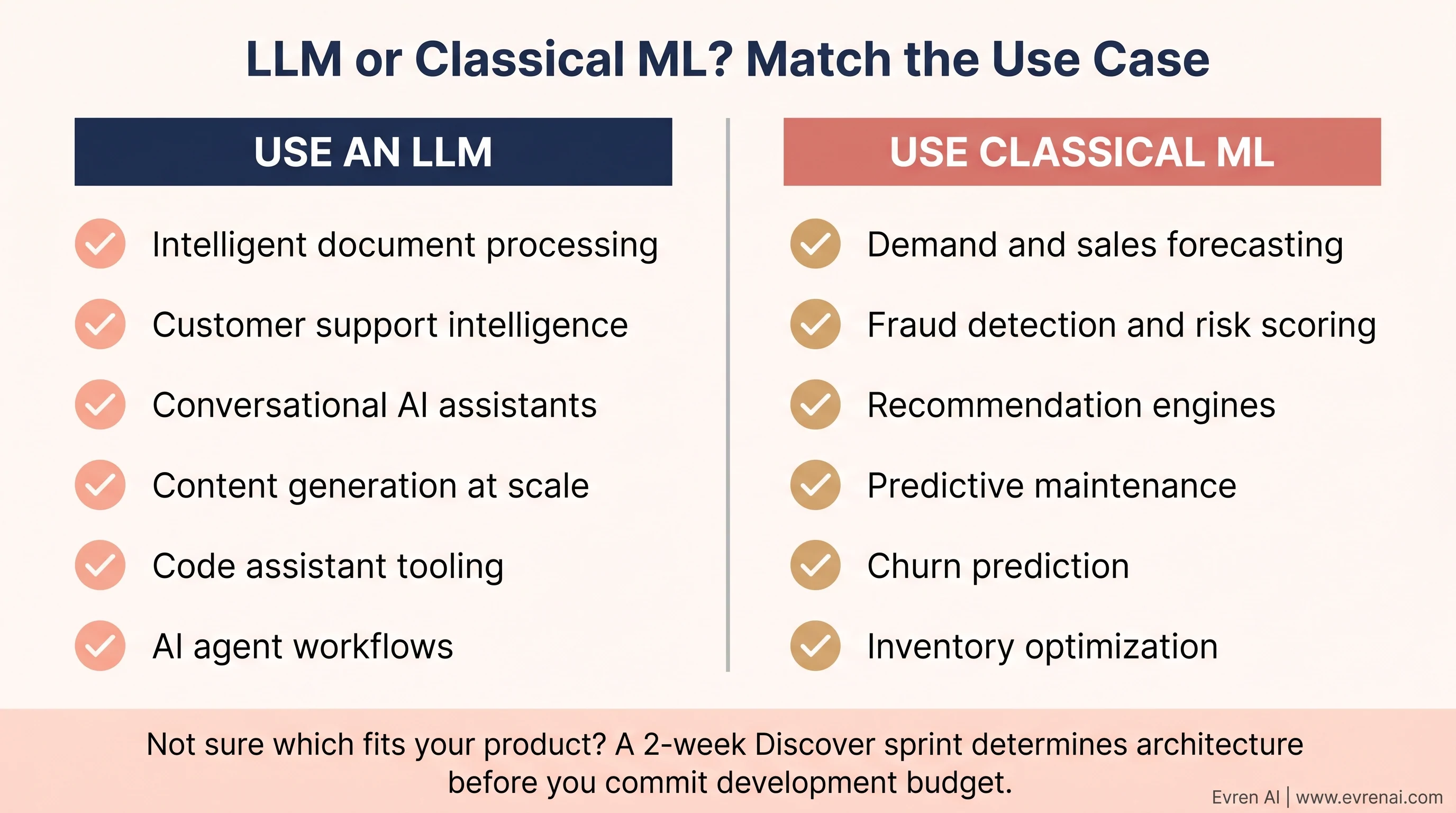
Intelligent document processing: extracting, summarizing, and routing information from contracts, invoices, and patient records. A London-based fintech company we worked with used Anthropic Claude to cut contract review time from four hours to 11 minutes per document, using Python and AWS Lambda. That is not incremental improvement. That is a different product category entirely. See our AI process automation work.
Customer support intelligence — triage, auto-response, and smart escalation routing at scale. Conversational AI for internal tools: employee-facing search, knowledge management, and HR assistants that understand natural language queries. Content generation at scale: product descriptions, localized marketing copy, structured report drafts. Code assistant tooling for internal developer productivity. AI agent workflows for multi-step enterprise back-office automation.
These use cases share one defining characteristic: the value delivered is impossible without natural language understanding. That is the reliable signal. See client outcomes.
When Classical ML Outperforms an LLM
Here is what most LLM guides will not say directly: for structured data problems, classical machine learning with Python and Scikit-learn outperforms LLMs on accuracy, latency, and cost. Often by a significant margin.
Demand forecasting, fraud detection, recommendation engines, risk scoring, predictive maintenance, and churn prediction all operate on structured, labeled datasets. Adding an LLM to these architectures introduces latency, unpredictability, and cost to problems that gradient boosting or logistic regression solve cleanly and reliably. Not every AI product needs a large language model. Knowing the difference is the skill that matters.
Think of architecture selection like choosing an orbital trajectory. Get the angle right at launch and the flight path corrects itself naturally. Choose the wrong path and every adjustment compounds the cost of getting back on course. See our machine learning approach.
Which Model: GPT-4, Claude, or Open-Source?
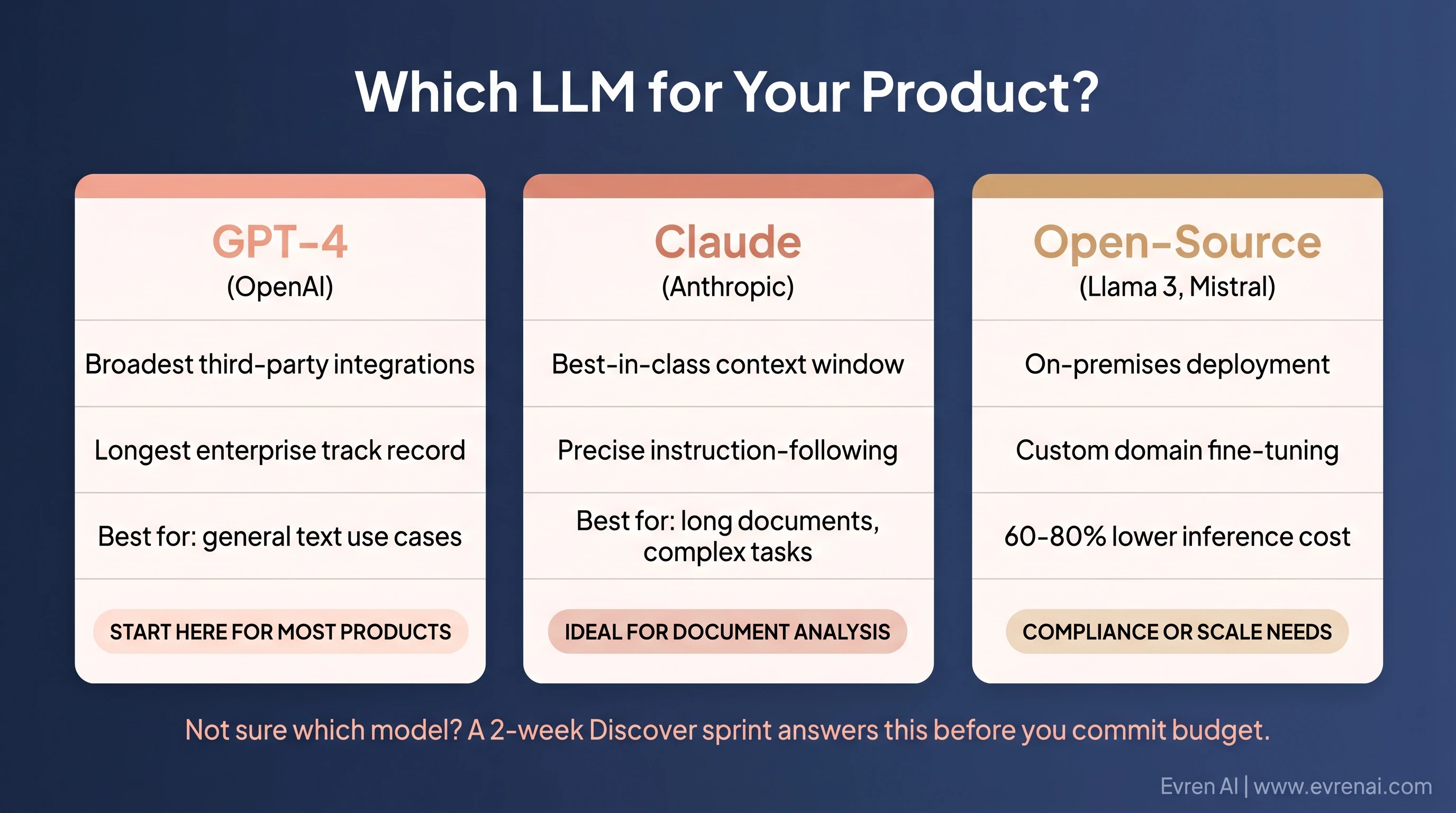
Once you have confirmed an LLM is the right architecture, the next question is which model. For most production text use cases, GPT-4 (OpenAI) and Claude (Anthropic) via API are the fastest and most capable starting points.
GPT-4 has broader third-party integrations and the longest enterprise production track record. Claude has a stronger context window for long-document tasks and more predictable behavior on complex multi-step instruction-following. Both are genuinely excellent. The real choice is driven by use case, not preference.
Open-source models — Llama 3, Mistral, Mixtral — make sense when compliance requires on-premises deployment, when proprietary domain data warrants fine-tuning, or when inference cost at projected scale makes hosted APIs economically unsustainable. Most teams should start with GPT-4 or Claude and migrate if constraints require it. Starting with custom fine-tuning from scratch adds four to six months to most roadmaps without proportional benefit at the start.
YOU HAVE THE VISION. WE HAVE THE TEAM.
Book a free 30-minute discovery call and tell us what you are building.
Here Is the Bottom Line
Deciding whether your product needs an LLM is not a technology question. It is a product question. Work through the four questions before committing architecture: Is the input primarily text? Does the output need contextual variation? Is the edge-case cost acceptable? Is the inference cost sustainable? Answer those honestly and the right architecture becomes clear.
At Evren AI, we partner with businesses of every size to build intelligent, human-centered digital products that solve real problems and create lasting value. AI is not a feature we add at the end. It is woven into our thinking from day one. When we hand a product over, your team can own it, evolve it, and grow it without needing us in the room.
Ready to decide if your product needs an LLM? Start here.
Have an idea? Let us talk.
Book a free consultation. Tell us what you are building and we will tell you honestly if an LLM is the right architecture — or if something simpler will deliver better results.
Book a Free ConsultationFrequently Asked Questions
Choosing the technology before defining the problem. The right sequence: define the problem with a measurable outcome, assess your data, then evaluate architecture options. An LLM solving the wrong problem precisely is still solving the wrong problem. A two-week discovery sprint prevents this almost entirely.
LLM integration typically adds $15K to $50K to development costs depending on context management complexity, retrieval architecture, and compliance requirements. Ongoing inference costs range from near-zero for small volumes to $2K to $8K per month at scale using GPT-4. Open-source models on AWS or GCP typically cost 60 to 80 percent less per inference than hosted API pricing.
Not for most use cases. LLM API integration using OpenAI GPT-4 or Anthropic Claude requires minimal proprietary training data at launch. You provide context via prompt engineering or retrieval-augmented generation. Fine-tuning with your own data makes sense when domain-specific precision is critical at scale or when you want to reduce prompt token costs over time.
For most production text use cases, start with GPT-4 or Anthropic Claude via API. GPT-4 suits broad integrations. Claude excels at long-document analysis and complex instruction-following. Open-source models like Llama 3 or Mistral make sense for on-premises compliance requirements, unique domain data, or when inference cost at scale is a constraint. A discovery sprint determines which path fits before development commits.
If your team can monitor API costs, manage prompt templates, and update retrieval pipelines, they can maintain most LLM integrations. At Evren AI, knowledge transfer sessions, technical documentation, and runbooks are built into every engagement from day one. The goal is full team independence within 90 days of launch. Dependency is not an outcome we design toward.