Most enterprise AI agent pilots look impressive in a demo. They route tickets, summarize contracts, and draft reports with a speed that impresses every stakeholder in the room. Then someone asks the question that actually matters: "Can we deploy this to 10,000 users next quarter?" That is where 70% of enterprise AI agent initiatives stall, according to Gartner's 2024 AI Deployment Outlook.
The gap between a functioning pilot and a production-grade autonomous agent is not a technology problem. It is an architecture problem. And it is one that follows a predictable pattern.
What Is an Autonomous AI Agent in Enterprise?
An autonomous AI agent is a software system that perceives its environment, reasons through a large language model, and takes multi-step actions to complete a defined business goal without constant human instruction. In enterprise settings, agents connect to internal tools, databases, and APIs to execute workflows from customer support triage to financial reporting automation.
The word "autonomous" matters. A standard chatbot responds to queries. An autonomous agent perceives context, selects the right tool from a set of options, executes a sequence of actions, and adapts when intermediate steps fail. That is why production deployment is meaningfully harder than building a responsive assistant.
Why Enterprise AI Agent Pilots Fail to Scale
We've seen this pattern more than 20 times. A team builds a compelling pilot in 6 weeks, demos it to leadership, gets budget approved, and then spends 6 months firefighting production failures. The model worked. The architecture around it didn't.
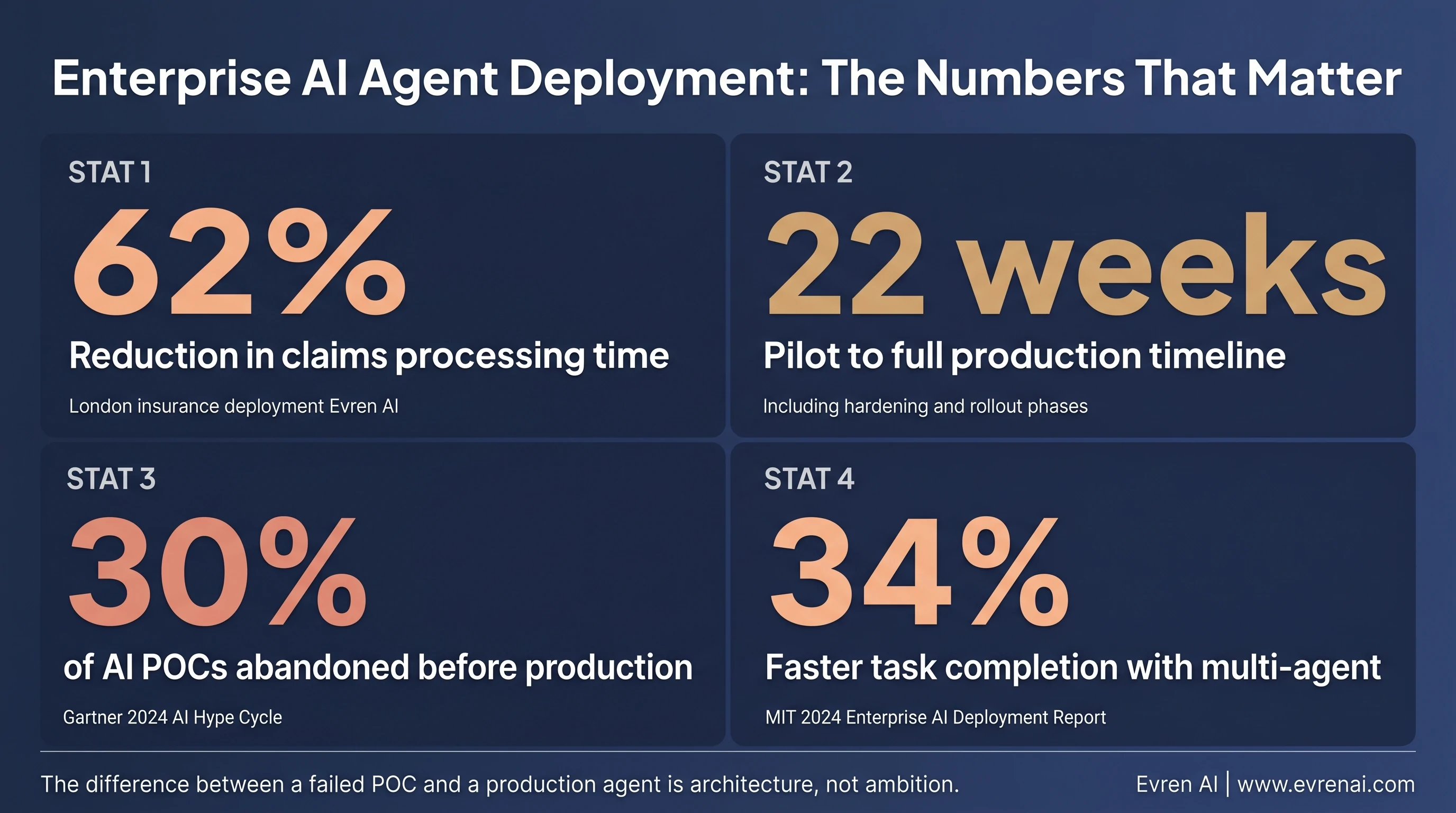
According to Gartner's 2024 AI Hype Cycle, 30% of generative AI proofs of concept are abandoned before reaching production. For autonomous agents, that failure rate is higher because the failure modes are more consequential. A single-turn chatbot fails quietly. An autonomous agent executing the wrong multi-step action fails with real operational impact.
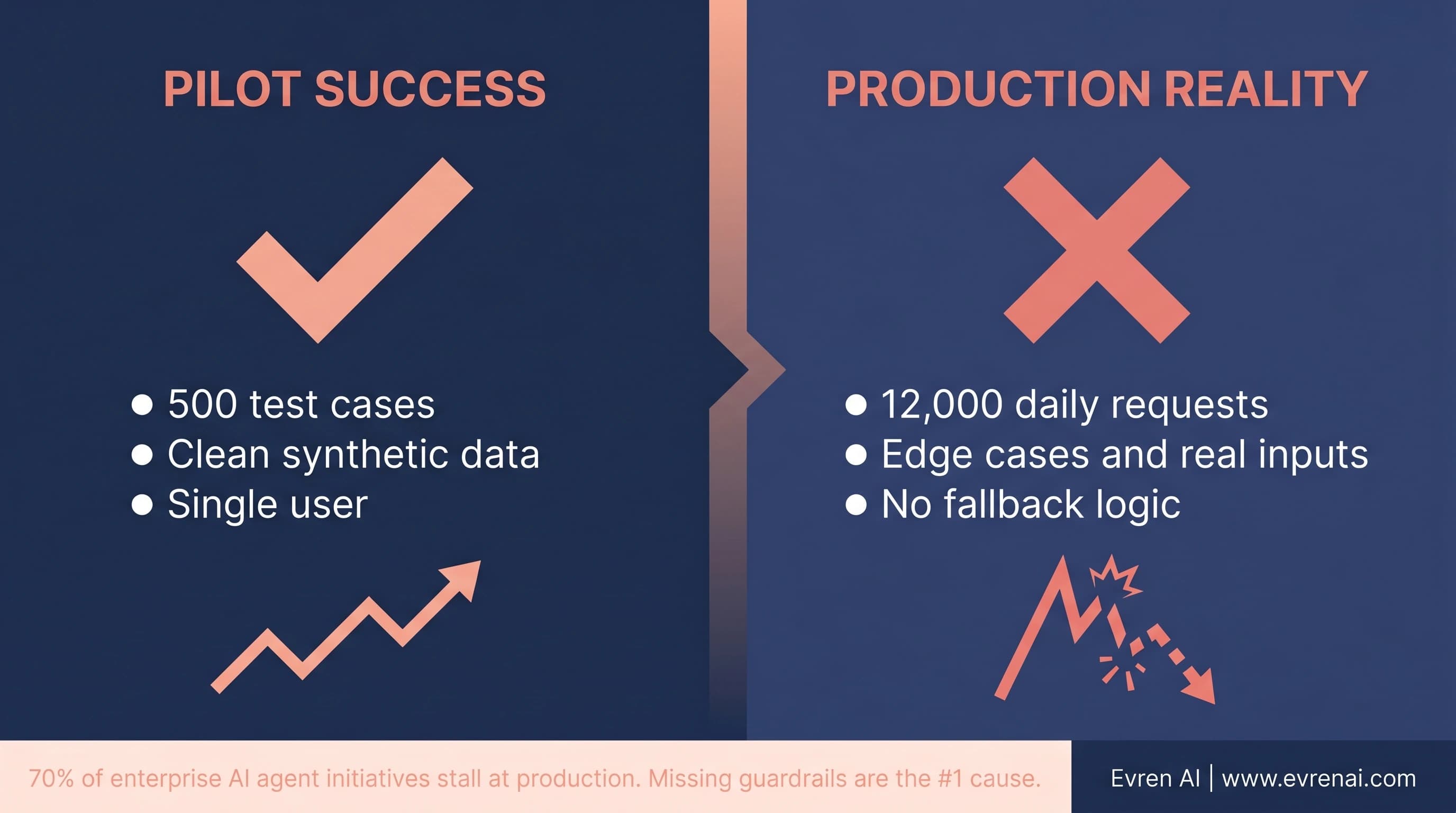
The three most common failure points are: no fallback logic when the LLM hallucinates, no audit trail for regulated industries, and no rate-limit management when agents call external APIs under real production load. A Chicago-based logistics company using LangChain and Google Cloud deployed an agent that worked perfectly in a sandbox with 500 test cases. In production with 12,000 daily requests, the error rate climbed to 22% within 4 days.
See our autonomous AI agent services.
Not every enterprise agent needs a custom-trained model. For most enterprise reasoning tasks, Anthropic Claude 3.5 Sonnet or GPT-4o via API handles 85% of use cases without fine-tuning. The real investment is the orchestration layer, memory architecture, and guardrails that determine whether an agent delivers in production or creates a support backlog.
The Four-Phase Framework: Pilot to Production
Think of moving an AI agent to production like mission control guiding a spacecraft from low orbit to deep space. The pilot is a test launch in controlled conditions. Production is the full mission. You don't skip trajectory planning because the test launch went smoothly.
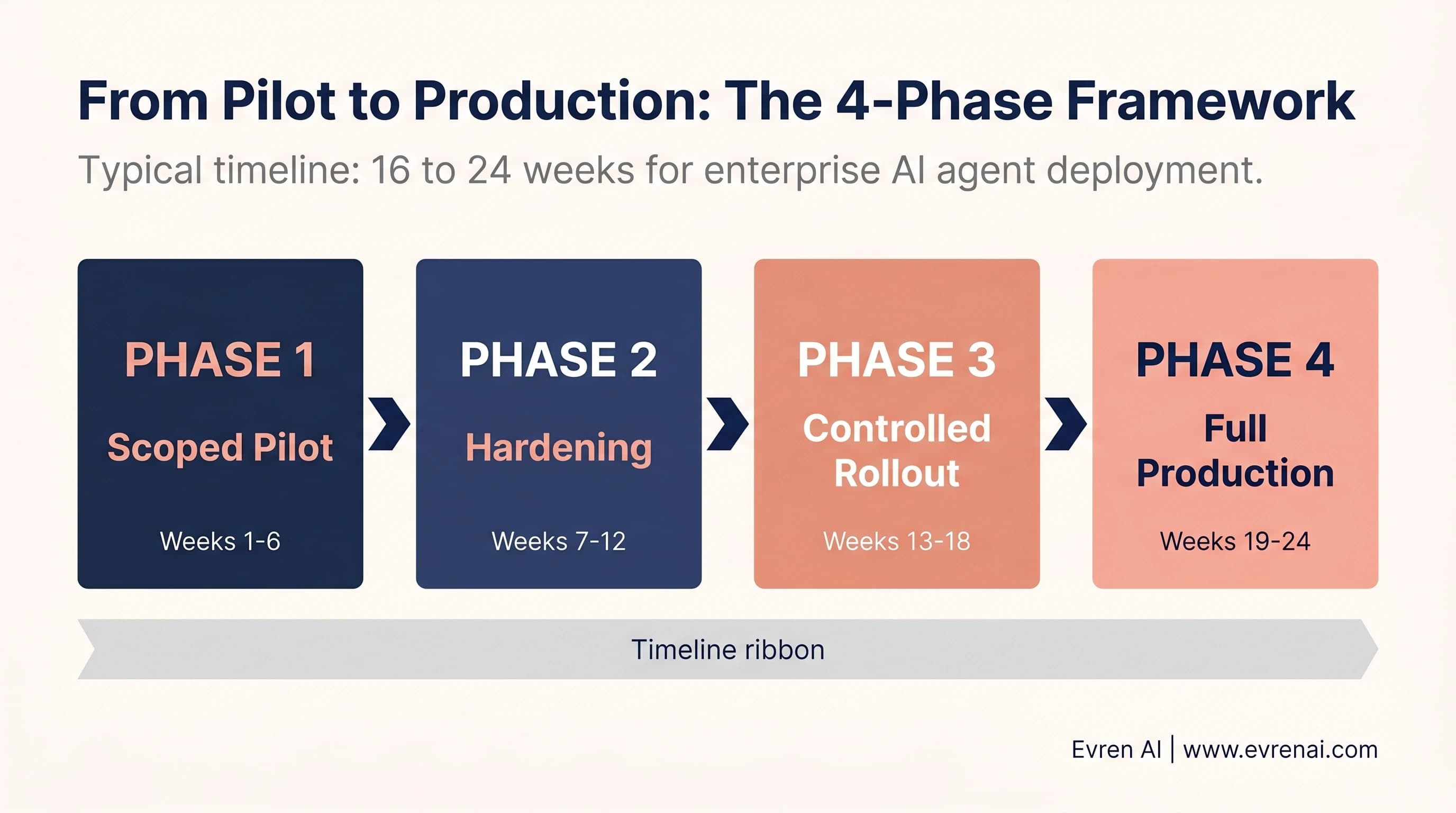
1. Scoped Pilot (Weeks 1 to 6)
- Define ONE workflow. Set ONE measurable success metric.
- Test with real production data, not synthetic samples.
- Use Python and LangChain for rapid agent scaffolding.
- Use Anthropic Claude or GPT-4o for reasoning.
- Goal: Is the use case viable with our actual data?
2. Hardening (Weeks 7 to 12)
- Add guardrails: output validation, confidence thresholds, human-in-the-loop triggers.
- Implement LLM fallback logic for hallucination cases.
- Add structured logging for every agent decision.
- This is the phase most teams skip. That decision costs them dearly.
3. Controlled Rollout (Weeks 13 to 18)
- Deploy to 5 to 10% of production traffic.
- Monitor error rates, latency, and hallucination frequency.
- Set SLA thresholds before expanding to full volume.
- Add HIPAA or SOC 2 audit layers for healthcare and fintech verticals.
4. Full Production and Knowledge Transfer (Weeks 19 to 24)
- Expand to full production traffic.
- Transfer operational ownership with complete documentation and runbooks.
- Model governance protocols handed to client team.
- Your team owns this agent without needing us on call. That is our standard.
See how we structure product delivery.
Choosing the Right LLM Architecture for Your Agent
AI is not a feature we bolt onto an agent after the architecture is already decided. The LLM choice, context window strategy, and memory architecture are decisions that shape every downstream component. That thinking starts on day one, not sprint twelve.
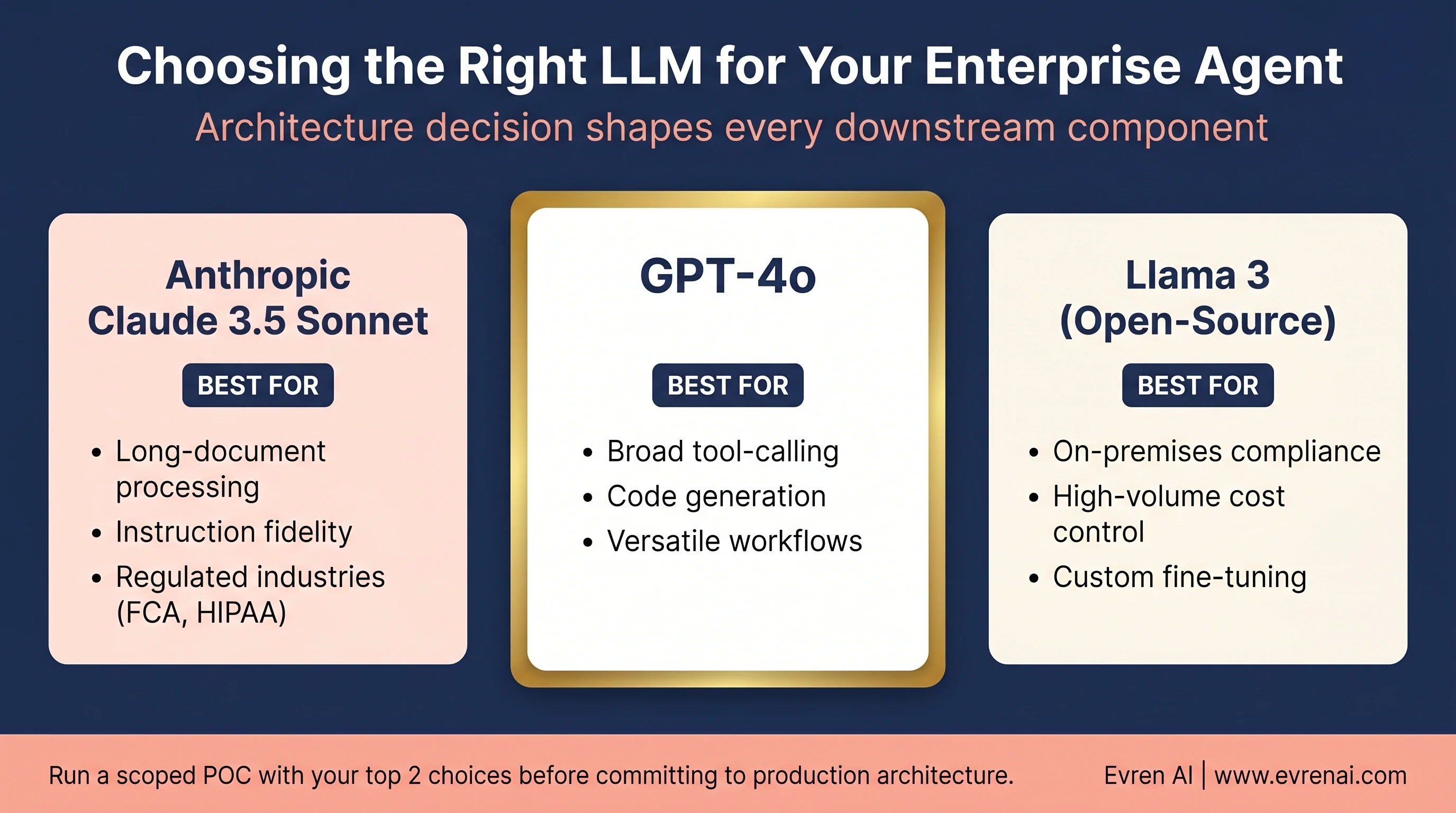
For most enterprise text-based agents, Anthropic Claude 3.5 Sonnet or GPT-4o via API is the right starting point. Both support 100K-plus context windows and native tool-calling sufficient for complex multi-step enterprise workflows. When compliance mandates on-premises deployment, open-source models like Llama 3.1 on AWS or Azure private cloud are the answer.
Complexity also drives architecture. Single-agent systems handle linear task chains reliably. For enterprise workflows requiring parallel task execution or cross-department coordination, multi-agent frameworks using AutoGen or LangGraph add resilience and modularity. According to MIT's 2024 Enterprise AI Deployment Report, enterprises using multi-agent architectures reduced average task completion time by 34% compared to single-agent equivalents. Like our namesake, we never stop learning what the right architecture is for each context, and the field is evolving fast enough that last year's best answer may not be this year's.
Explore our generative AI integration services.
Building something with AI agents?
We help enterprise teams move from functioning pilot to production-grade deployment. Let us show you the roadmap.
What Production-Grade Enterprise Agents Actually Look Like
A London-based insurance company we worked with, using Python, AWS Lambda, and Anthropic Claude, deployed an agent processing 3,000-plus claims documents daily. It routes complex cases to human adjusters and maintains a complete audit trail for FCA regulatory compliance. From scoped pilot to full production took 22 weeks. The agent reduced claims processing time by 62%.
The difference between their pilot and their production system was not the model. It was three things: proper error handling for edge cases the pilot never encountered, a human escalation protocol for decisions below a confidence threshold, and a monitoring dashboard their operations team could actually interpret without needing a data scientist in the room.
We partner with teams through every phase of this journey. We are not a vendor who hands off code and moves on. We embed ourselves in deployment, monitoring setup, and team training so your team is running the agent with confidence, not calling us in a panic six months after launch.
See our proven results across 50+ AI products.
Here Is the Bottom Line
Autonomous AI agents work in production. The teams that reach production successfully share one thing: they planned the journey, not just the destination.
At Evren AI, we partner with enterprises of every size to build intelligent products that solve real problems and create lasting value. Our success is measured by your independence: when we hand over a production-grade autonomous agent, your team can operate it, evolve it, and scale it without needing us on call. We build products and capabilities so your team can own, evolve, and grow what we create together.
If you are running an AI agent pilot and wondering what it takes to reach production, let us talk. www.evrenai.com/contact.
Ready to take your AI agent to production?
Book a free consultation. We will assess your pilot and outline your production roadmap.
Book a Free ConsultationFrequently Asked Questions
Most enterprise AI agent deployments take 16 to 24 weeks from scoped pilot to full production. Pilots take 4 to 6 weeks with real data. Hardening adds 4 to 6 weeks. Controlled rollout takes another 4 to 6 weeks. Teams that skip hardening typically add 4 or more months of rework in production, making it the most expensive shortcut in agent deployment.
Enterprise AI agent deployment typically ranges from $80K for a focused, single-workflow agent to $300K or more for multi-agent systems with compliance requirements, custom LLM fine-tuning, and complex API orchestration. Main cost drivers: scope, compliance tier (HIPAA, SOC 2, FCA), and whether existing infrastructure supports integration or requires a rebuild.
Anthropic Claude 3.5 Sonnet excels at long-document processing and maintaining instruction fidelity across complex multi-step tasks. GPT-4o has broader tool-calling capability and stronger code generation. For regulated industries requiring strict output controls, Claude's Constitutional AI design adds a practical safety layer. Run a scoped POC with both models before committing to production architecture.
Missing guardrails. Pilots succeed in controlled conditions with clean test data and limited input range. Production introduces edge cases, unexpected inputs, and high-volume load. Without output validation, confidence thresholds, and human escalation protocols, agents fail loudly. According to Gartner, 30% of generative AI POCs are abandoned. The hardening phase is the difference.
Rarely, at first. Most enterprise agent use cases achieve production performance using Claude or GPT-4o via API, combined with well-designed prompting and retrieval-augmented generation for domain context. Custom fine-tuning makes sense when task volume justifies cost, domain language is highly specialized, or compliance mandates on-premises deployment with open-source models like Llama 3.