
Your finance team approved the AI automation pilot. Your operations team ran it for 90 days. Now someone in the boardroom is asking what you actually got for that investment.
Most teams answer with one number: labor hours saved. That's not wrong. It's just incomplete. And it's why 67% of executives surveyed by McKinsey report that AI investments have underdelivered expectations.
The technology isn't failing them. Their measurement is.
What Is ROI for AI Process Automation?
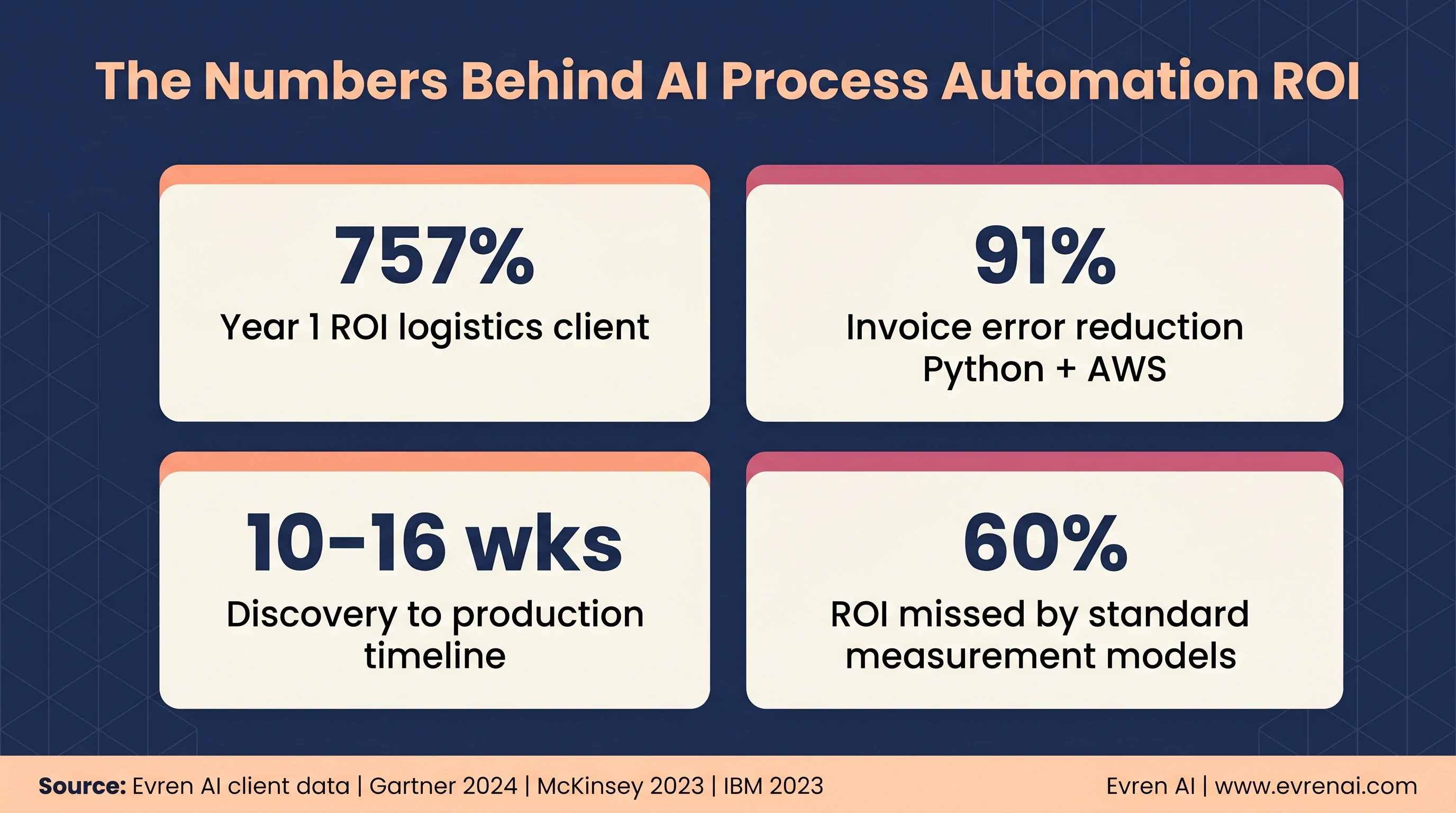
AI process automation ROI is the measurable financial return generated when intelligent systems replace or augment manual workflows. It combines direct savings (labor costs, error rates, processing time) with indirect gains (faster decisions, higher throughput, reduced rework). Most businesses undercount ROI because they measure only labor savings and miss the indirect value drivers that account for 60% of total return.
The 6 ROI Metrics Most Businesses Miss
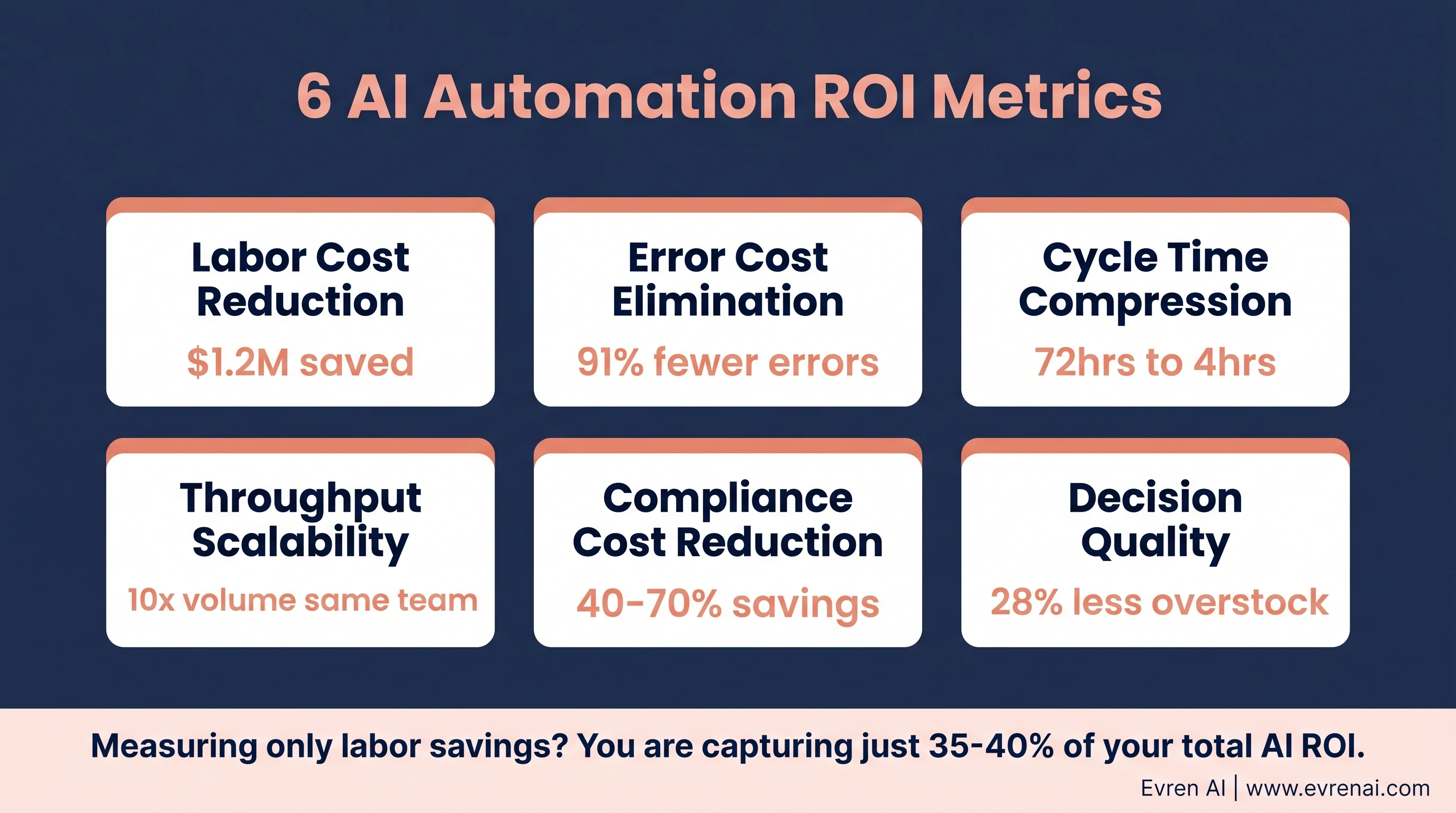
Labor cost reduction is obvious. Everybody counts it. But according to Gartner's 2024 Intelligent Process Automation Survey, companies that measure only labor savings capture just 35-40% of total AI automation value. You're leaving 60% of your ROI story on the table.
1. Error Cost Reduction
Manual data entry carries error rates of 4-8% in high-volume workflows, per IBM's 2023 Process Mining Report. Each error has downstream cost: rework, customer impact, compliance exposure. A Houston-based fintech company using Python and AWS reduced invoice processing errors by 91% after deploying AI document extraction. The annual rework cost they eliminated was $340,000. None of that appeared in their original ROI model.
2. Cycle Time Compression
When a process that took 72 hours completes in 4, that's not just faster. It's revenue unlocked sooner, customer satisfaction improved, and working capital freed. Speed has a dollar value. Most finance teams don't know how to assign it, but that doesn't make it imaginary.
3. Throughput Scalability
Manual processes scale linearly with headcount. Automated processes scale with compute. A system processing 10,000 records today handles 100,000 with no additional labor cost. That scalability ceiling is worth quantifying before peak season tests it. Always Expanding is how we think about this: the ceiling keeps moving.
4. Compliance Cost Reduction
In regulated industries, automated audit trails and consistent process execution reduce compliance labor by 40-70%, per Deloitte's 2024 Automation in Regulated Industries report. We've seen healthcare teams using LangChain and FastAPI cut compliance preparation time from 3 weeks to 4 days.
See our AI Process Automation services.
5. Employee Redeployment Value
When people stop doing repetitive tasks, they don't disappear from payroll. They either do more valuable work, or they don't. Companies that plan the redeployment strategy before automating capture significantly more value than those who treat it as an HR afterthought. Not every team gets this right the first time.
6. Decision Quality Improvement
AI systems catch patterns humans miss in high-volume structured data. An e-commerce company we worked with reduced overstock inventory by 28% after deploying demand forecasting automation built with Python and AWS. That's $1.2M in freed working capital, not from cutting headcount but from better decisions.
A Real ROI Calculation: What the Full Picture Looks Like
Think of AI automation ROI like orbital mechanics. There are visible forces you can calculate from the ground, and invisible forces that only become apparent when you map the complete trajectory. Most businesses plot only the visible ones and wonder why the mission underperforms.
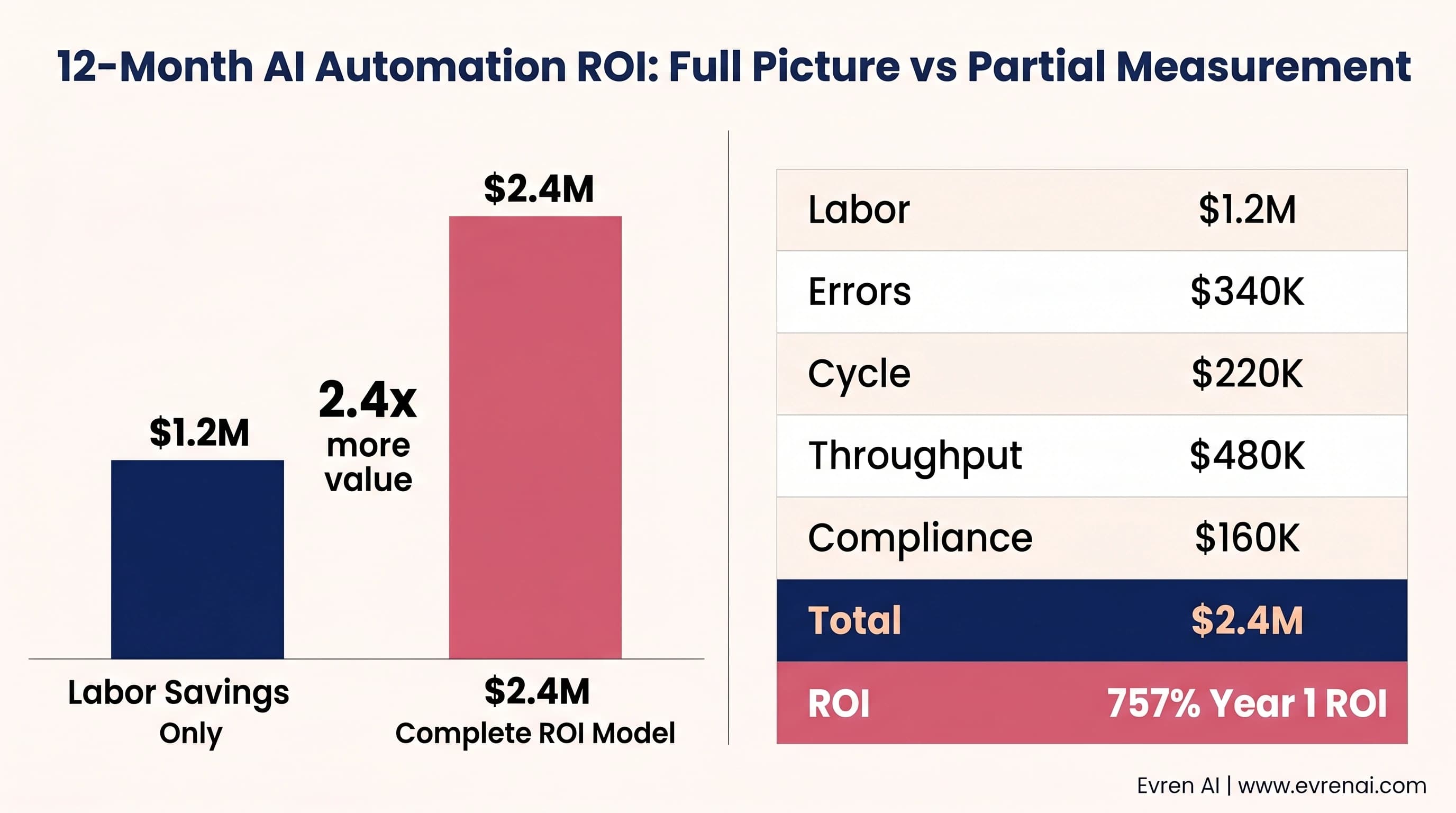
Here's a real 12-month ROI model from a mid-market logistics company. The structure mirrors work we did with a Singapore-based operations team facing identical data volume challenges, where data standards differed but the architecture principle held perfectly.
| 12-Month ROI Model Category | Annual Value |
|---|---|
| Labor hours saved (equivalent 30 FTE) | $1,200,000 |
| Error correction costs eliminated | $340,000 |
| Cycle time improvement (revenue unlocked faster) | $220,000 |
| Throughput increase (40% volume growth, zero new headcount) | $480,000 |
| Compliance preparation time reduced | $160,000 |
| Total Annual Value | $2,400,000 |
| Implementation Cost | $280,000 |
| Year 1 ROI | 757% |
Measuring only labor savings would have shown $1.2M return on $280K investment. The complete picture is 2.4x better. That difference is the business case for measuring correctly.
Want a custom ROI estimate for your process?
We map your current process baseline and build a 12-month ROI model specific to your industry, workflow volume, and compliance requirements. No generalities.
When AI Process Automation Doesn't Deliver ROI
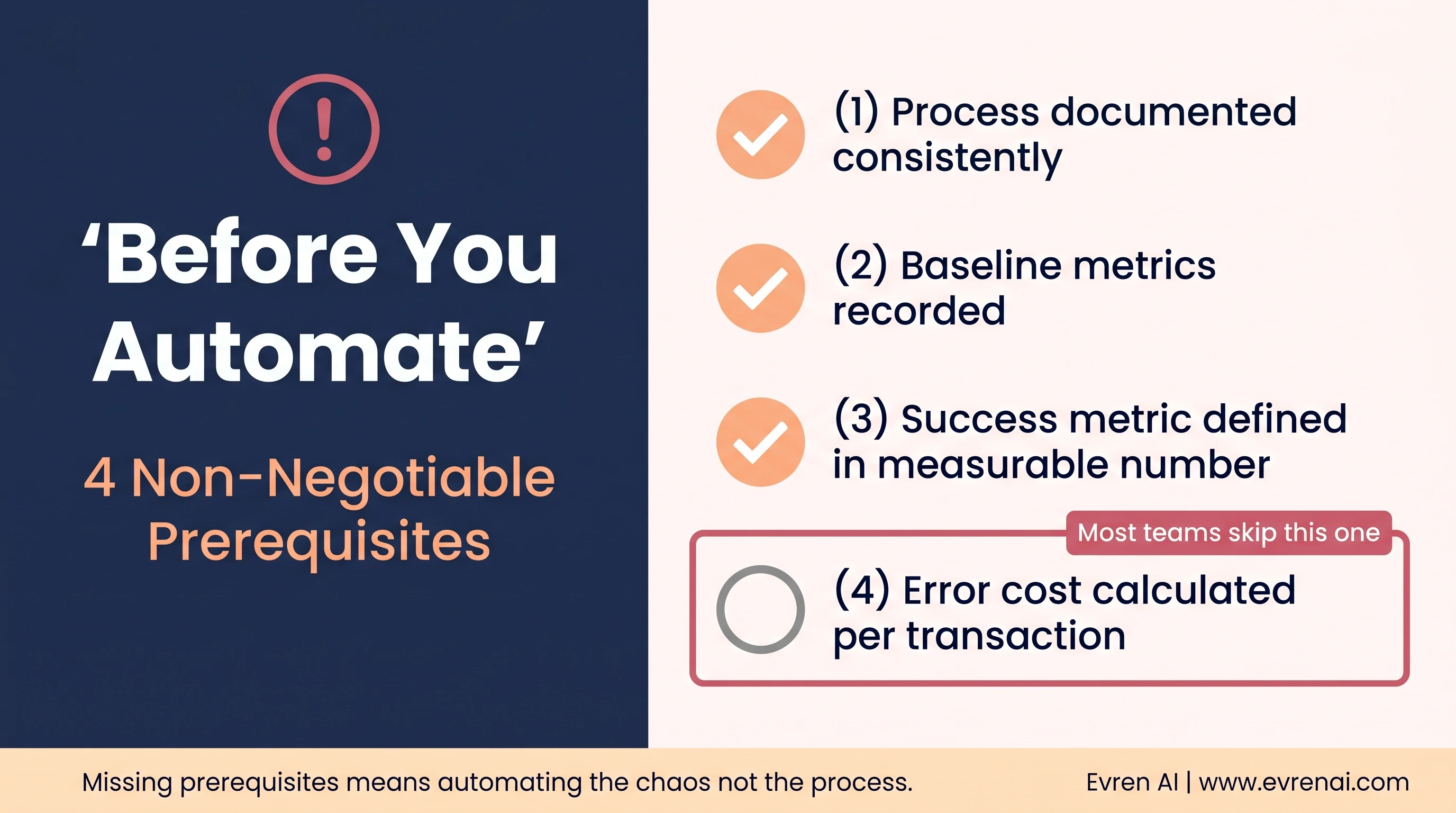
Here's what most guides don't tell you: AI process automation has one non-negotiable prerequisite. Your process needs to be measurable before it's automatable.
We've seen teams invest $150,000 automating a process that was never documented consistently. The AI system learned the chaos, not the process. That's not an AI failure. It's a process discovery failure wearing an AI mask.
Before committing any automation budget, answer three questions with specifics. What exact task will AI perform? What does success look like in a number measurable today? What's the cost when the system makes an error? If any answer is vague, you're not ready to build. AI is intelligent by design at Evren AI. That means clarity before code. Every build begins with empathy for the problem.
See our product development process.
3 Steps to Build Your AI Automation ROI Business Case
Before committing any automation budget, answer three questions with specifics, not generalities. What exact task will AI perform? What does success look like in a measurable number today? What's the cost when the system makes an error?
Step 1: Map Your Process Baseline
Document current state: time per transaction, error rate, daily volume, headcount assigned, and compliance overhead hours per week. You need today's numbers to credibly claim tomorrow's savings. No baseline means no ROI proof.
Step 2: Identify Which ROI Categories Apply
Not every category fits every use case. An internal HR workflow has a different ROI profile than a customer-facing document processing system. Map which of the six categories apply, then assign conservative estimates using real inputs.
Step 3: Build a 12-Month Model with Full Costs
Include everything: discovery and scoping, development, LLM API usage if using Claude or GPT-4 via API, integration work, team training, and ongoing monitoring fees. Most teams underestimate ongoing costs by 30-40%. Build that buffer in from the start.
We partner with businesses of every size to build intelligent, human-centered digital products that solve real problems and create lasting value. Our success is measured by your independence: when the automation is live, your team can own it, monitor it, and expand it without depending on us. If you want a specific ROI estimate for your process, let's talk: www.evrenai.com/contact.
Ready to calculate your automation ROI?
Our team builds the business case, scopes the implementation, and delivers automation your team fully owns.
Book a Free ConsultationFrequently Asked Questions
Strong Year 1 ROI for AI process automation ranges from 200-500% for focused, well-scoped workflows. Enterprise-wide deployments typically show 150-300% in Year 1 with returns accelerating in Years 2-3. The standard benchmark for a sound business case is recovering full implementation costs within 12-18 months. Single-process automation almost always hits payback in under 12 months.
Most focused AI process automation projects go from discovery to production in 10-16 weeks. Scope, data quality, integration complexity, and compliance requirements like HIPAA or SOC 2 affect timeline. Discovery alone takes 2-3 weeks for complex regulated processes. Teams that skip discovery typically add 3-5 months of rework after their first automation falls short of expected performance.
High-volume, data-intensive processes with clear input/output definitions deliver the strongest ROI: document processing, invoice management, customer request routing, demand forecasting, compliance reporting, and quality control. Processes with measurable error rates and documented business rules automate most reliably. Unstructured workflows with no documented baseline produce inconsistent results.
Robotic Process Automation follows fixed rules on structured data. AI process automation handles unstructured inputs like documents, emails, and images, makes context-sensitive judgments, and improves over time. For text-heavy workflows, LLM integration using Claude or GPT-4 via API outperforms traditional RPA with far less rules-maintenance overhead and significantly better handling of edge cases.
Start with your current error rate (typically 4-8% for data-intensive workflows). Multiply by daily error volume, then assign cost per error: rework time at loaded labor rate, customer impact value, and compliance penalty exposure. Most teams discover their error cost is 2-3x higher than expected. That number belongs in your ROI model from day one, not discovered after automation is live.