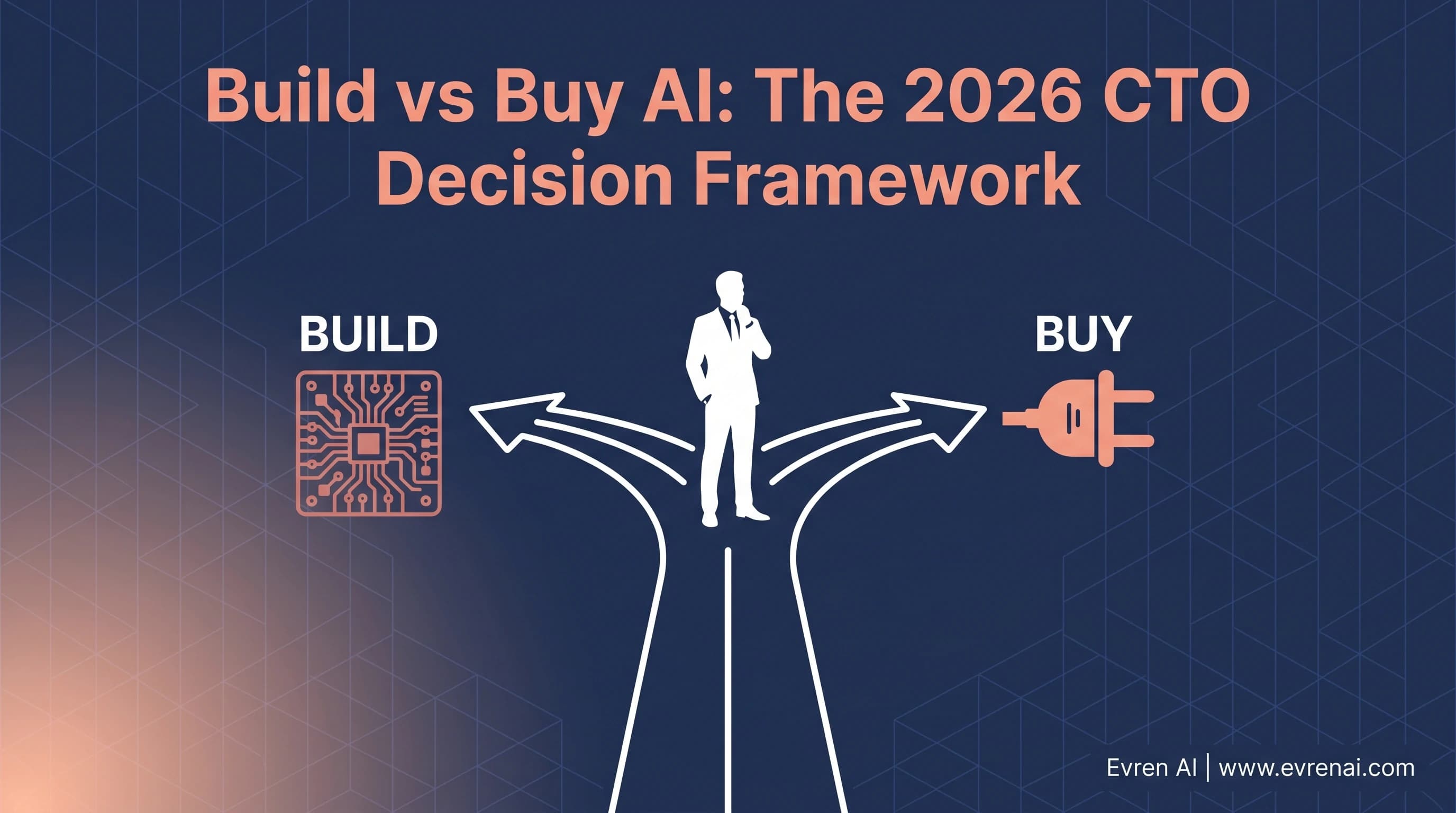
Your board just approved the AI budget. Your engineers are ready. But before you commit $300K to development, one question will determine whether this project succeeds or becomes a six-figure lesson in avoidable mistakes: should you build this AI capability yourself, or buy it?
Too many teams treat this as a philosophical debate. It isn't. It's a four-variable calculation, and the answer changes dramatically depending on your data, your timeline, and where your competitive advantage actually lives.
What Is the Difference Between Building and Buying AI?
Building AI means developing custom models, pipelines, or products using your own engineering team, proprietary data, and infrastructure. Buying AI means licensing a vendor platform, SaaS solution, or LLM API from providers like OpenAI, Anthropic, or Google. In 2026, most effective AI strategies combine both: buy foundational LLM capability and build your differentiated product logic on top.
The line between the two has blurred significantly. Using Anthropic Claude or GPT-4 via API isn't buying a finished product. It's leasing raw intelligence and building your application layer on top. Understanding that distinction changes the whole framework. See our generative AI integration services.
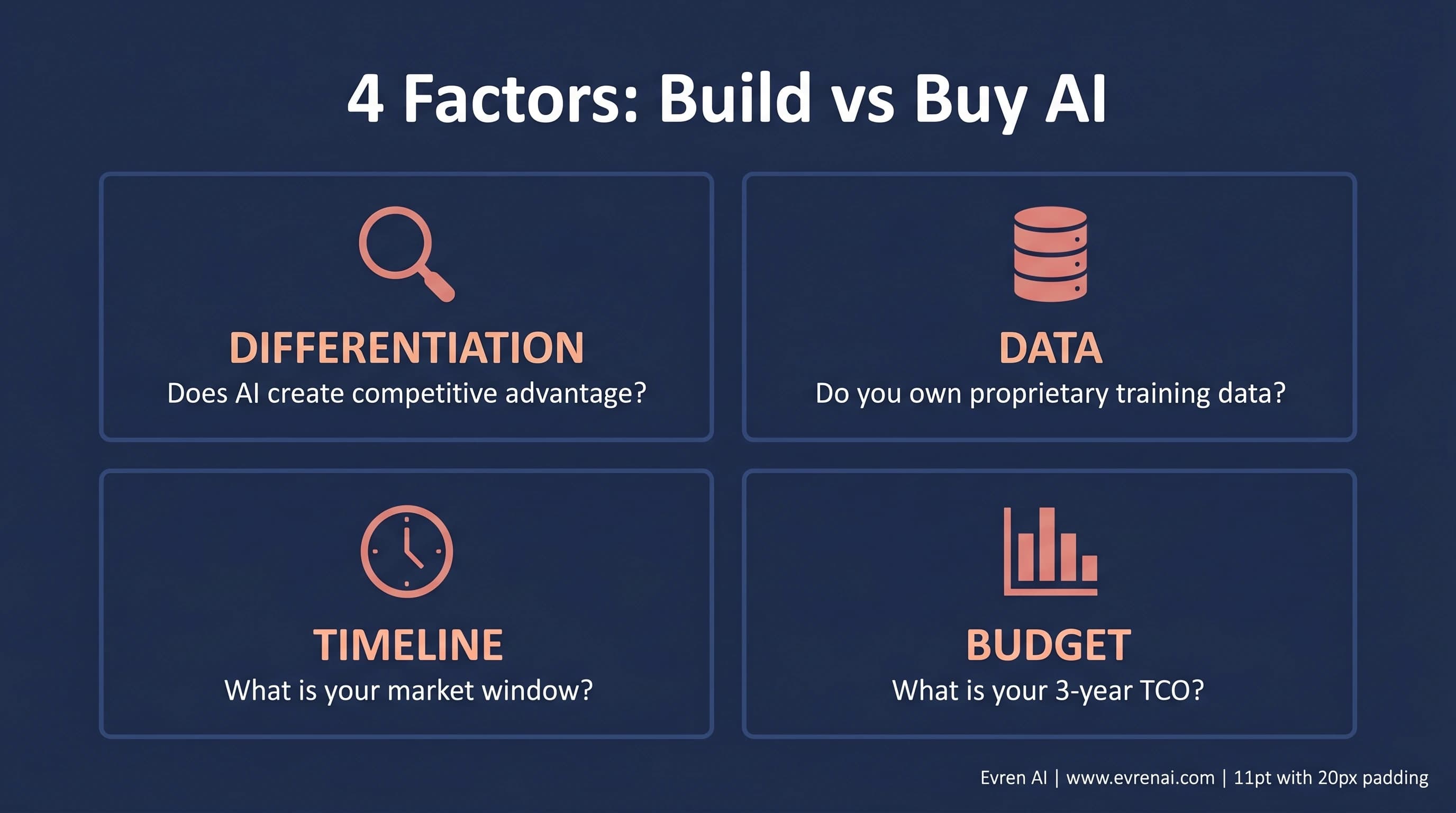
The 4 Factors That Decide Every Build vs Buy Choice
Most teams answer this question emotionally. CTOs with strong engineering cultures default to building. CFOs with tight budgets default to buying. Neither is right without examining four specific variables.
The first is differentiation. Does AI create competitive advantage specific to your business? If every competitor can license the same SaaS tool and achieve the same result, building a custom solution won't create a moat. What does "better" look like in a number you can measure?
The second is data. Do you own proprietary training data that makes your model meaningfully more accurate than a vendor's? A Houston-based logistics company we worked with had 6 years of route and delay data using Python and AWS. Their demand forecasting model outperformed every off-the-shelf API by 41%. That kind of proprietary data justifies building.
The third is timeline. According to Gartner, 67% of enterprise AI initiatives are delayed by more than 6 months. Building custom takes 10-24 months from discovery to production. Buying a vendor solution or deploying an LLM API product can be live in 4-12 weeks. What does your market window actually allow?
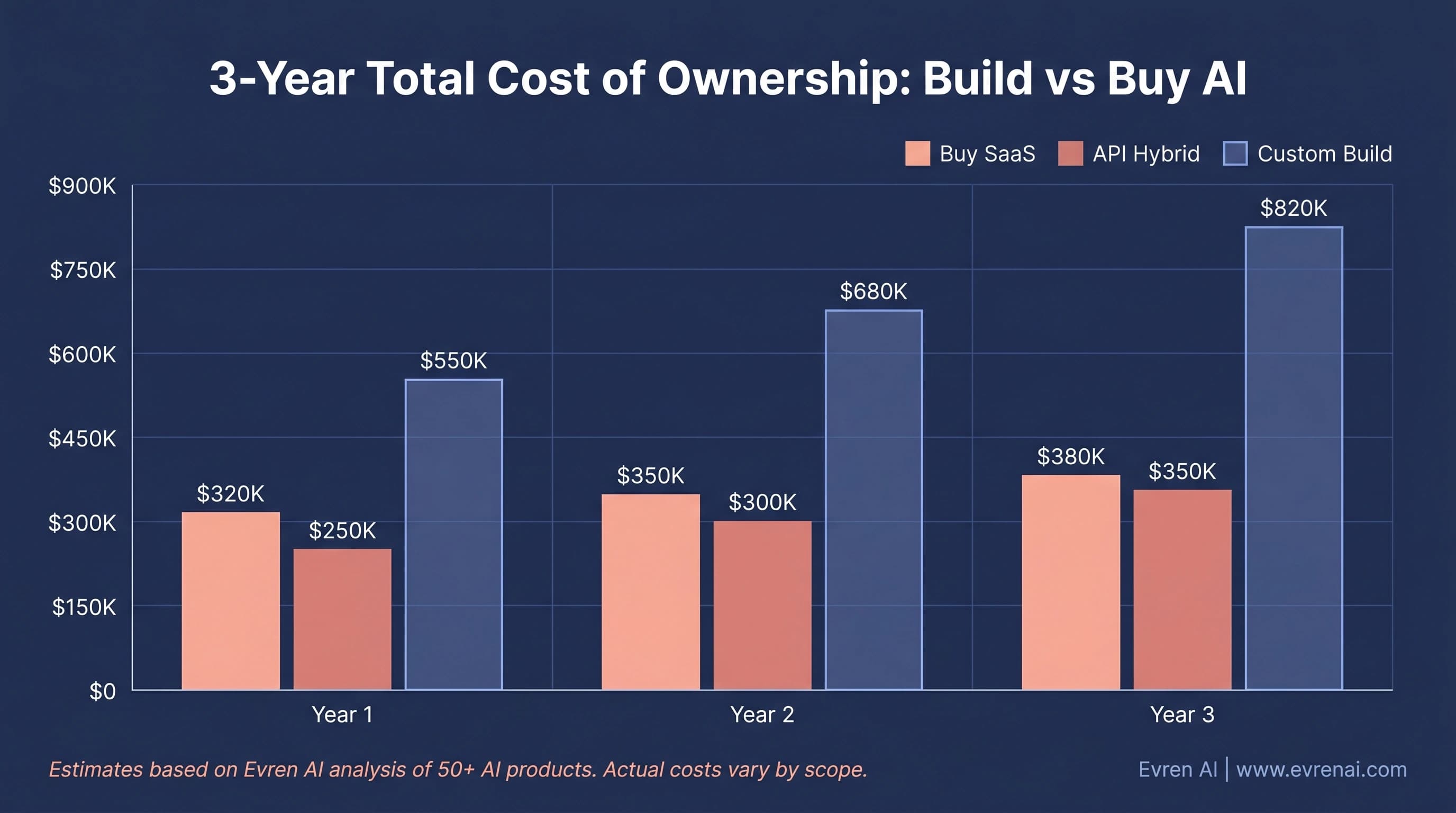
The fourth is budget. Custom AI builds cost $150K-$800K upfront with ongoing maintenance costs. SaaS licensing runs $50K-$500K per year. Neither number tells the whole story without calculating total cost of ownership over 3 years, vendor lock-in exposure, and the cost of features you'll eventually need to build anyway.
When Building Custom AI Makes Sense
Not every AI product needs to be built from scratch. But three scenarios consistently justify custom development, and confusing them with anything less is expensive.
First: you have proprietary data that gives your model capabilities no vendor can replicate. Second: your use case requires specialized accuracy that no off-the-shelf tool achieves within 70% of what you need. Third: compliance requirements like HIPAA, FedRAMP, or SOC 2 Type II mandate on-premises deployment and complete data control.
Not sure if your use case justifies a custom build?
Our Discover phase gives you a clear answer in 4 weeks: data audit, architecture recommendation, and build vs buy verdict with cost and timeline attached.
We've seen teams spend $400K building what should have been a $60K API integration. AI is not a competitive advantage just because you built it yourself. The advantage comes from what makes your version uniquely better than anything a competitor can buy.
Think of your AI architecture as a constellation. The LLM is the brightest star, already burning. Your proprietary data, fine-tuning logic, and product layer are the stars in orbit around it. That is exactly where your competitive edge lives.
When Buying AI Wins
Buying wins in more scenarios than most technical teams want to admit. Here is the honest question: does building give you a real edge, or does it just feel better because your team wrote the code?
OpenAI GPT-4o, Anthropic Claude 3.5 Sonnet, and Google Gemini 1.5 have solved general text reasoning, summarization, classification, and code generation with capabilities that would take a team of 8 ML engineers 18 months to replicate. According to McKinsey's 2024 AI State Report, companies that buy AI capabilities and customize via prompt engineering reach ROI 2.3x faster than teams building from scratch.
If AI is a feature in your product, not the product itself, buying is almost always faster and cheaper. The test is not "Can we build this?" It's "Does building this give us a 10x advantage worth the 18-month wait?" Explore our generative AI integration services.
The LLM Exception Most CTOs Miss
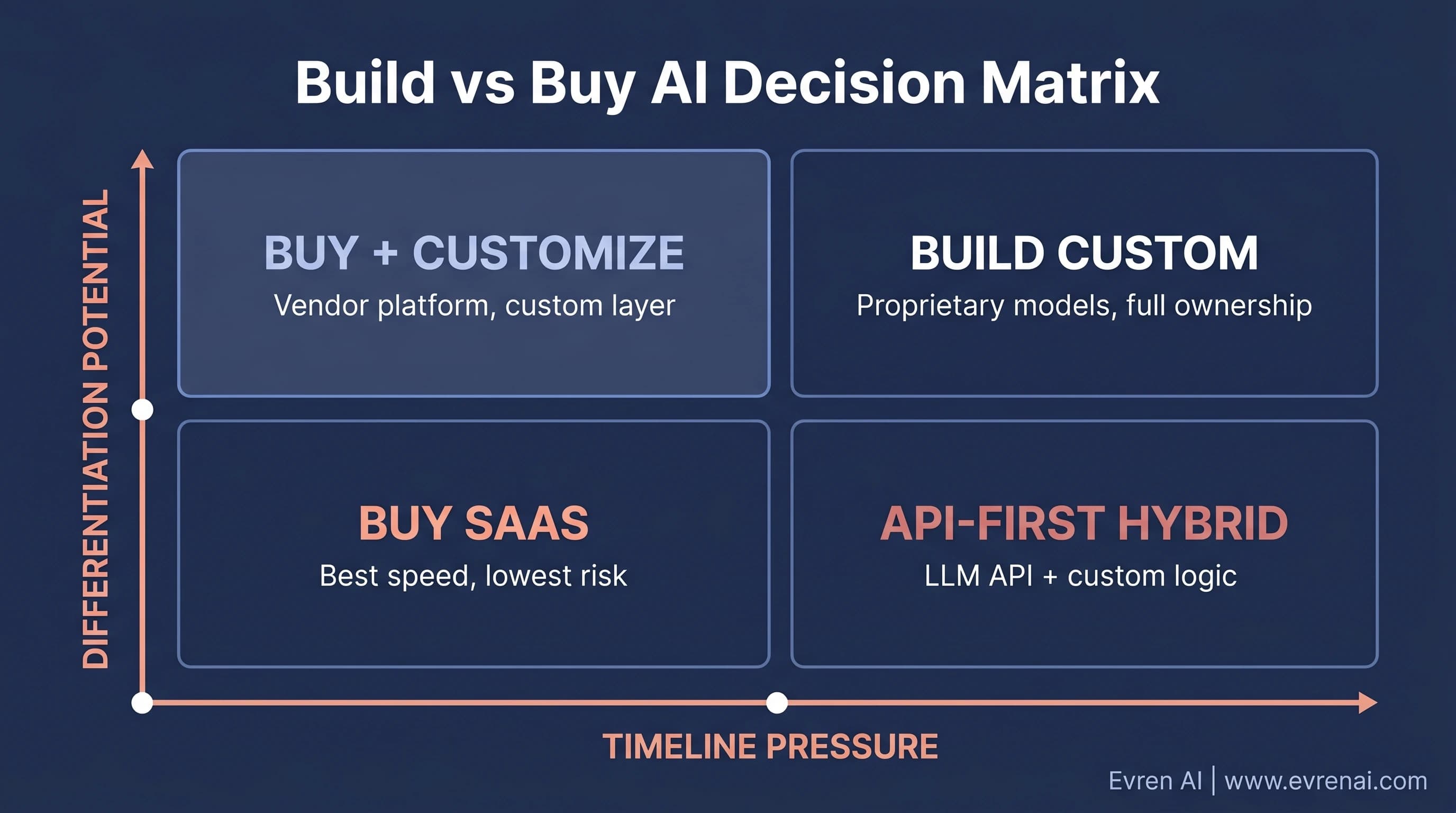
Here is what most build vs buy frameworks written before 2024 completely missed: the emergence of LLM APIs created a third option that sits between buying a SaaS product and building a custom model from scratch.
API-first LLM integration is not buying a finished product. You're accessing raw intelligence via API from Anthropic or OpenAI, then building your product logic, retrieval-augmented generation pipelines, and orchestration layer on top with LangChain and your own infrastructure. That is building a product. The foundation just happens to be Claude 3.5 or GPT-4 instead of a model you trained yourself.
A London fintech CTO we consulted with spent four months evaluating whether to fine-tune their own LLM for financial document analysis. The answer was no. Anthropic Claude via API with a RAG layer solved 94% of their use cases at one-eighth the cost of fine-tuning. They redirected the saved budget to ship their product three months earlier. Explore autonomous AI agent development.
A Decision Framework Your Team Can Use This Quarter
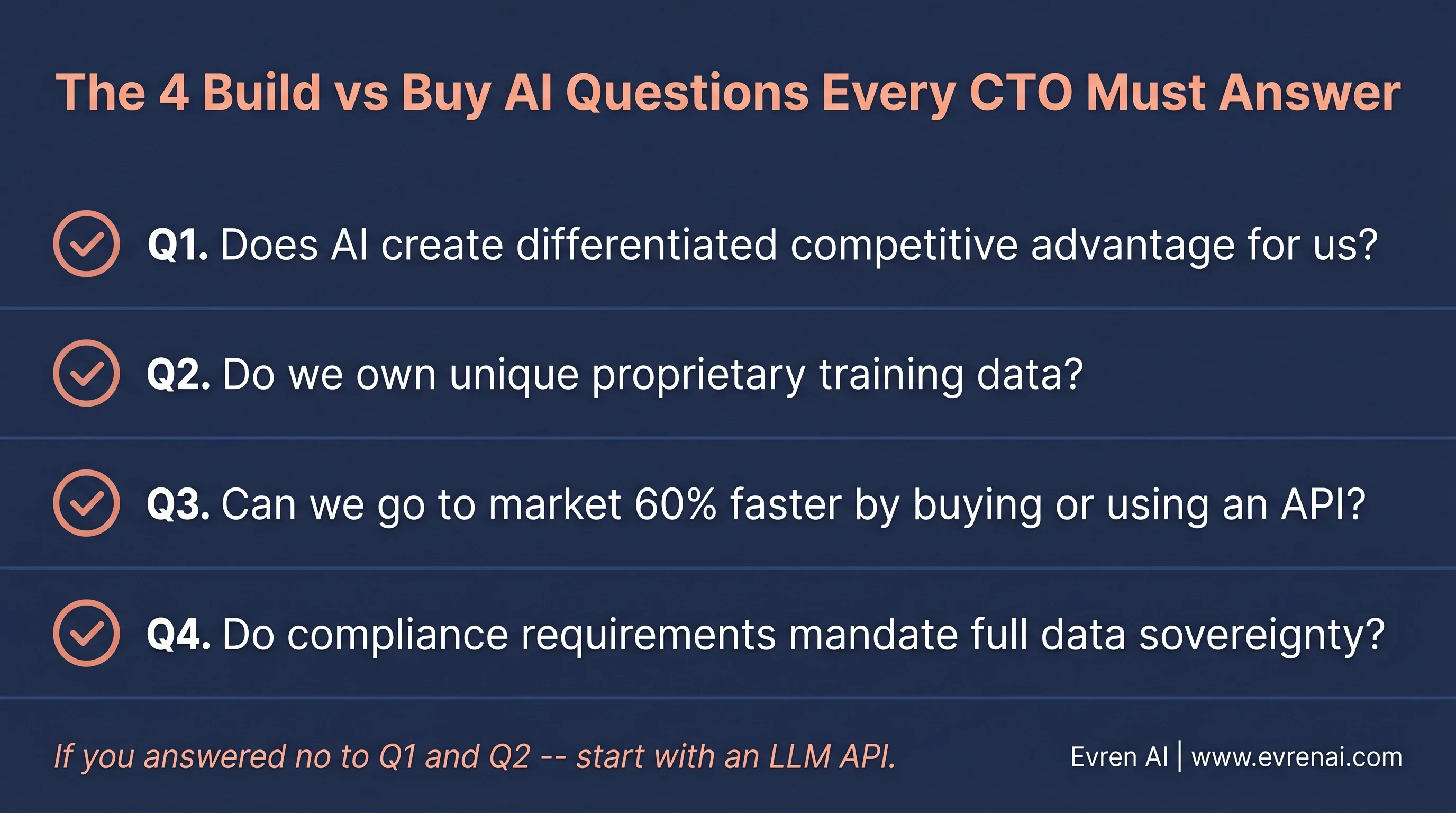
Run these four questions before your next AI budget conversation. Require specific answers, not generalities. Vague answers mean you are not ready to decide.
Question 1: Does our competitive advantage depend on AI being better than anything a competitor can buy? If yes, build or fine-tune. If no, buy.
Question 2: Do we own unique training data that makes our model meaningfully more accurate? If yes, consider building. If no, start with an LLM API first.
Question 3: Can we reach market 60% faster with a bought or API-first solution? If yes, buy first. Validate market assumptions. Build custom later when they are proven.
Question 4: Do compliance requirements mandate data sovereignty? If yes, build on-premises or in your own cloud. No shortcut exists for this one.
Have a Build vs Buy Decision to Make?
We run this framework for free in an initial consultation. You leave with a clear recommendation, cost range, and timeline, backed by 50+ AI product launches.
At Evren AI, we partner with businesses of every size to build intelligent, human-centered products that solve real problems and create lasting value. We've applied this exact framework across 50+ AI product launches. Our success is measured by your independence: when we hand over a product, your team owns it, evolves it, and grows it without needing to call us back. If you need a third-party perspective on your build vs buy decision, let's talk: www.evrenai.com/contact. See proven AI outcomes.
Ready to make your build vs buy decision?
Get a clear recommendation, cost range, and timeline backed by 50+ AI product launches.
Book a Free ConsultationFrequently Asked Questions
Custom AI development ranges from $150K for a focused MVP to $800K or more for enterprise-grade systems with complex architecture and compliance requirements. Cost drivers include data quality, team size, compliance scope (HIPAA, SOC 2 Type II), and whether you are building from scratch or integrating with LLM APIs. A Discover phase typically costs $15K-$25K and defines exact scope before full build begins.
Three main risks: vendor lock-in after you are deeply integrated and pricing power shifts, feature misalignment when their roadmap diverges from your product needs, and data security exposure when customer data leaves your environment. Mitigation: choose vendors with clean API abstraction layers, audit contracts for data handling clauses, and always maintain the ability to switch foundation models without rebuilding your full application layer.
Yes. Using GPT-4 or Claude via API is fundamentally different from buying a finished SaaS product. You are accessing raw LLM capability and building your own product logic, RAG pipelines, and application layer on top. Most enterprise AI products in 2026 use this hybrid model: LLM API as foundation, proprietary orchestration and data as the differentiation. That is building, not buying.
Custom AI development: 10-24 months from discovery to production depending on scope and compliance requirements. Vendor SaaS solution deployment: 4-12 weeks. API-integrated LLM product: 8-16 weeks from discovery to launch when architecture is scoped upfront. A well-defined AI MVP using LLM APIs can go live in 10-16 weeks when the Discover phase is included. Timeline is the strongest practical argument for the API-first approach for most use cases.
Deciding based on technical capability instead of strategic fit. Most engineering teams can build almost anything given enough time and budget. The question is whether building creates competitive advantage worth the timeline and cost. Teams that skip the differentiation question spend $400K on custom builds that a $60K per year vendor solution would have solved equally well for their specific use case.