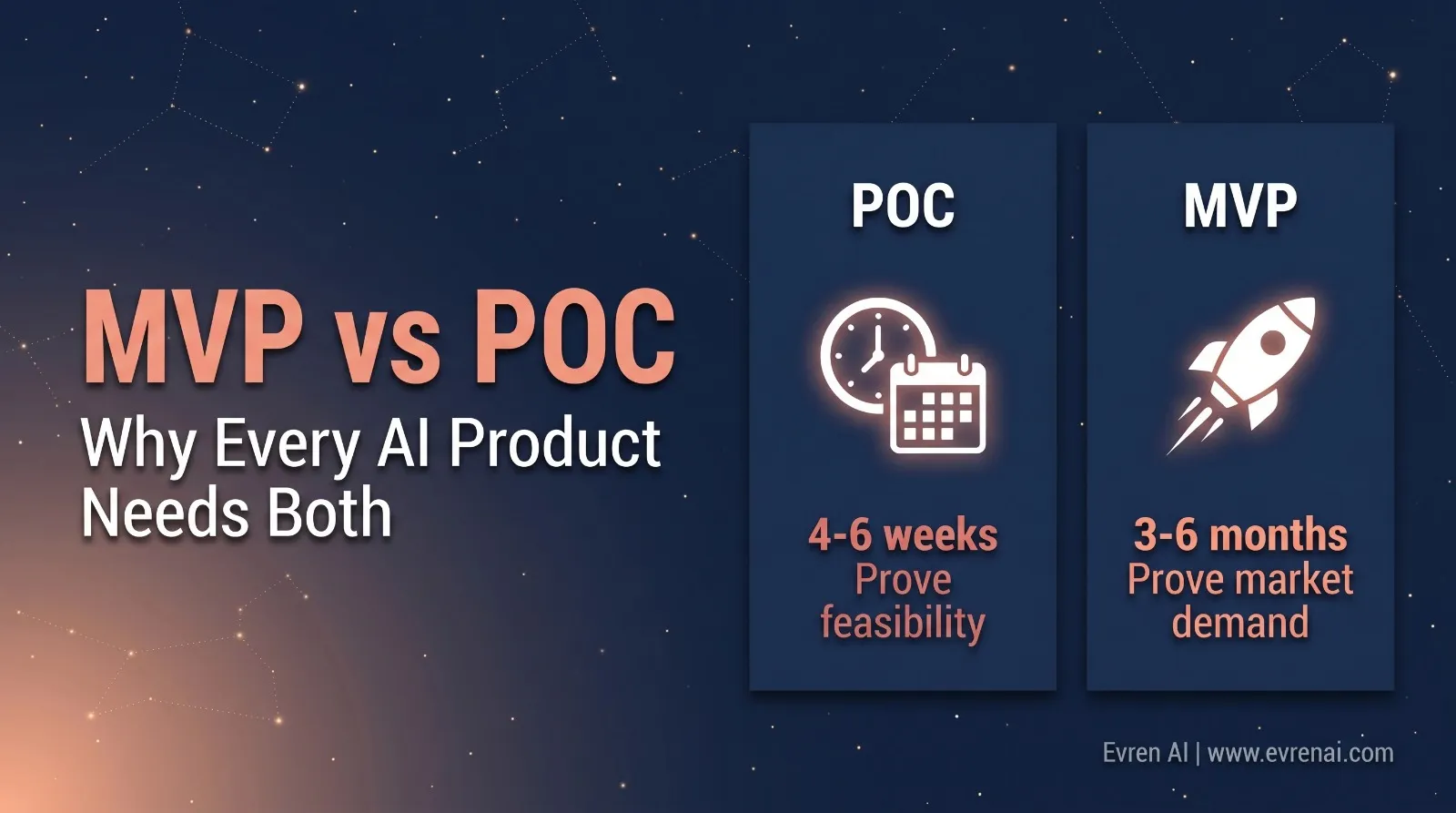
You have an AI idea. You're excited about it. But committing $150,000 to development without testing first is a risk most founders can't afford to take twice. That's where most teams get stuck: should you run a proof of concept, or jump straight to an MVP?
Too many teams skip validation entirely. They build for eight months, launch to silence, and spend another four months rebuilding what they should have tested in week three. At Evren AI, we've seen this pattern more times than we'd like to count. The good news is it's avoidable. And it starts with understanding what a POC and MVP are actually for.
What is the Difference Between MVP and POC?
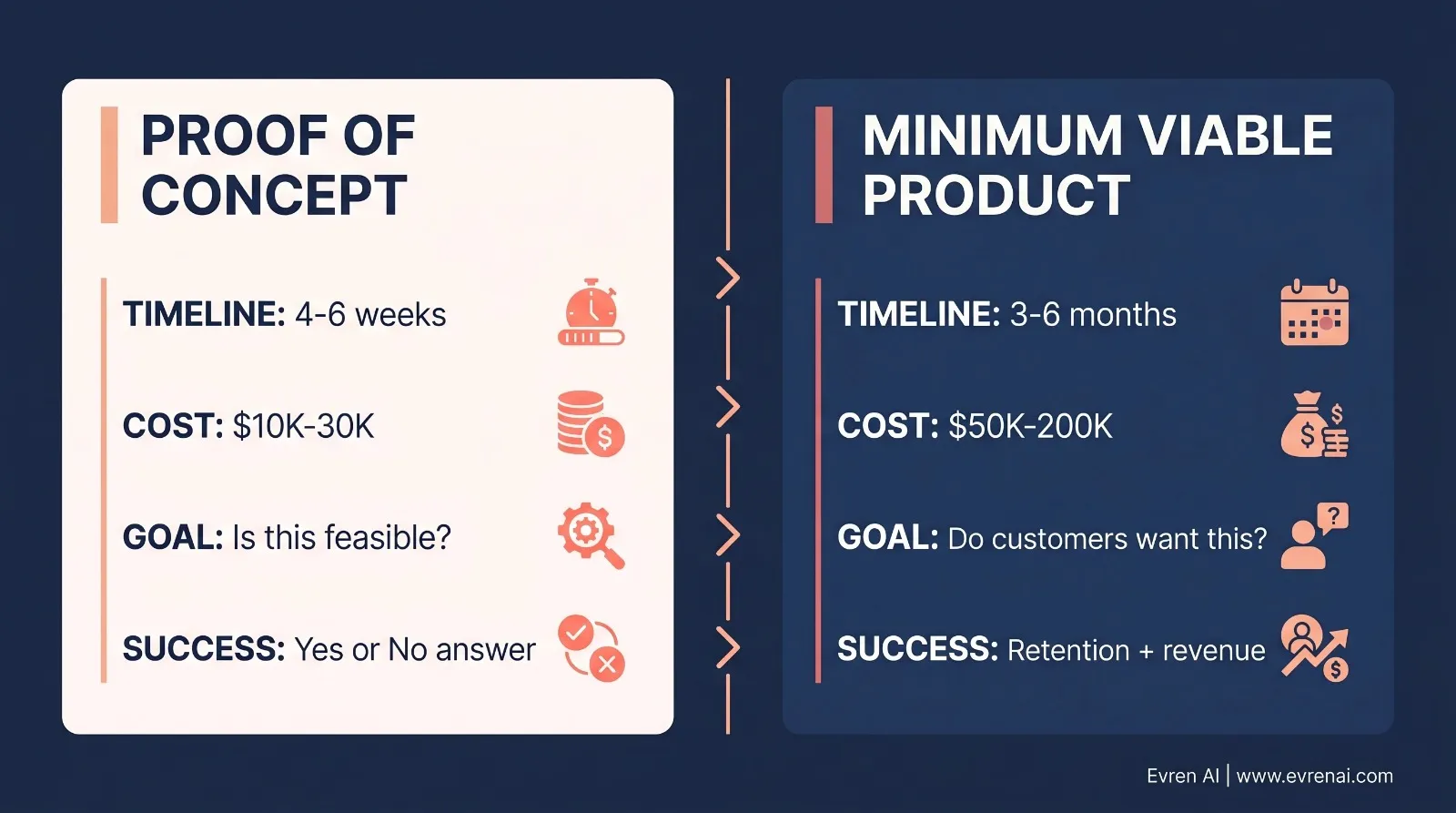
A POC (Proof of Concept) is a time-limited, risk-mitigation experiment designed to answer one question: 'Is this technically feasible with our data?' It runs 4-6 weeks, uses minimal resources, and proves or disproves a single assumption. An MVP (Minimum Viable Product) is a market-ready product designed to answer: 'Do customers actually want this?' It runs 3-6 months, includes real users, and validates the business model, not just the technology.
That's not a subtle distinction. It's the difference between a product that works and one that's permanently fighting its own architecture.
When to Run a POC First
Run a POC when your biggest risk is technical. That means you don't yet know if your AI approach will actually work with your specific data, your infrastructure, or your compliance constraints.
Signs you need a POC:
- You're planning to use an LLM (GPT-4, Anthropic Claude) on proprietary or unstructured data
- Your use case requires a performance benchmark you haven't proven (95% accuracy, sub-200ms latency)
- You're uncertain whether to fine-tune a model or use prompt engineering at scale
- Regulatory requirements (HIPAA, SOC 2) may affect architecture decisions
According to Gartner, 30% of generative AI projects are abandoned after proof of concept. That number isn't a failure of technology. It's a failure to ask the right question before committing to build.
A Houston-based logistics company we worked with had 18 months of unstructured shipment data stored on AWS S3. They wanted a demand forecasting model. Before building anything, we ran a 5-week POC. The finding: their data quality issues would have caused the MVP to underperform by roughly 40%. We caught it in week five, not month nine.
When to Go Straight to MVP
Run an MVP when your biggest risk is market-based. Technical feasibility is already proven, or your use case doesn't require novel AI architecture. Your question isn't 'can we build this' but 'will anyone pay for it.'
This is where most product leaders get stuck. They treat every AI product as technically uncertain when many are simply LLM integrations via API. For text-based products using OpenAI GPT or Anthropic Claude, the API call is not your risk. The business model is.
An MVP includes real users, measures business metrics, and validates your assumptions about customer behaviour. Think of each sprint as a trajectory correction. You're not launching blindly into the universe; you're adjusting course with real signal at every stage.
EVREN AI - INTELLIGENT BY DESIGN
AI is not a feature we add at the end. It is woven into our thinking from day one, shaping how we discover, build, and scale every product.
Building an AI product? Book a free consultation
The Sequence That Actually Works
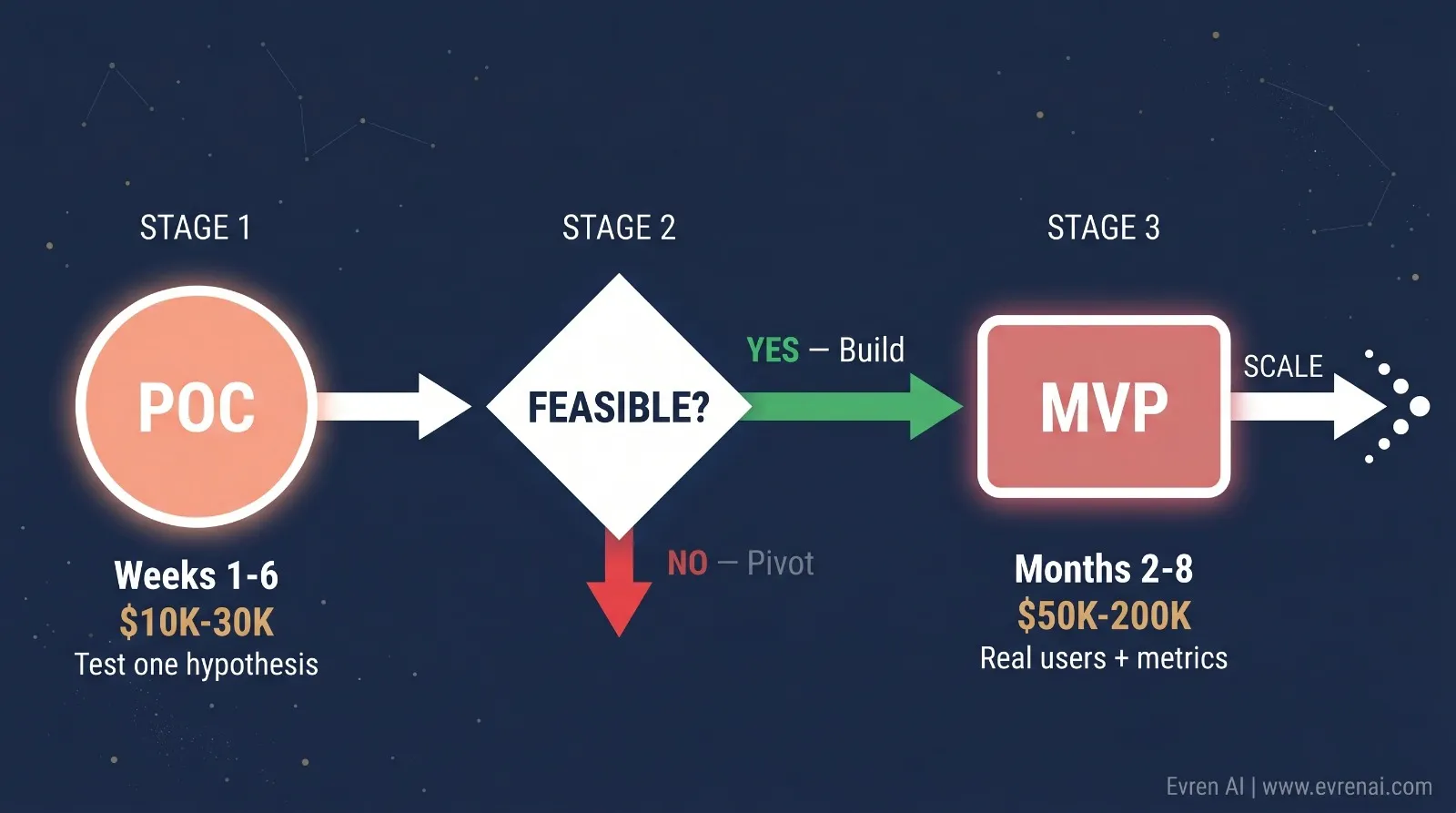
Not every AI product needs both. But many high-risk products benefit from running them sequentially. POC first to answer 'can we?' and MVP second to answer 'should we and will anyone care?'
Here's what that looks like in practice:
Phase 1 - POC (Weeks 1-6, $10K-30K)
- Define one hypothesis: 'GPT-4 can classify customer support tickets into 12 categories with 90%+ accuracy using our 6-month dataset'
- Test with minimal infrastructure: Python, FastAPI, one developer, your actual data
- Pass/fail decision: Did we prove or disprove the hypothesis?
Phase 2 - MVP (Months 2-8, $50K-200K)
- Design the user experience around a proven technical foundation
- Build with LLM integration (OpenAI GPT or Anthropic Claude) baked into the architecture from sprint one
- Release to a small user group, measure retention and task completion, not vanity metrics
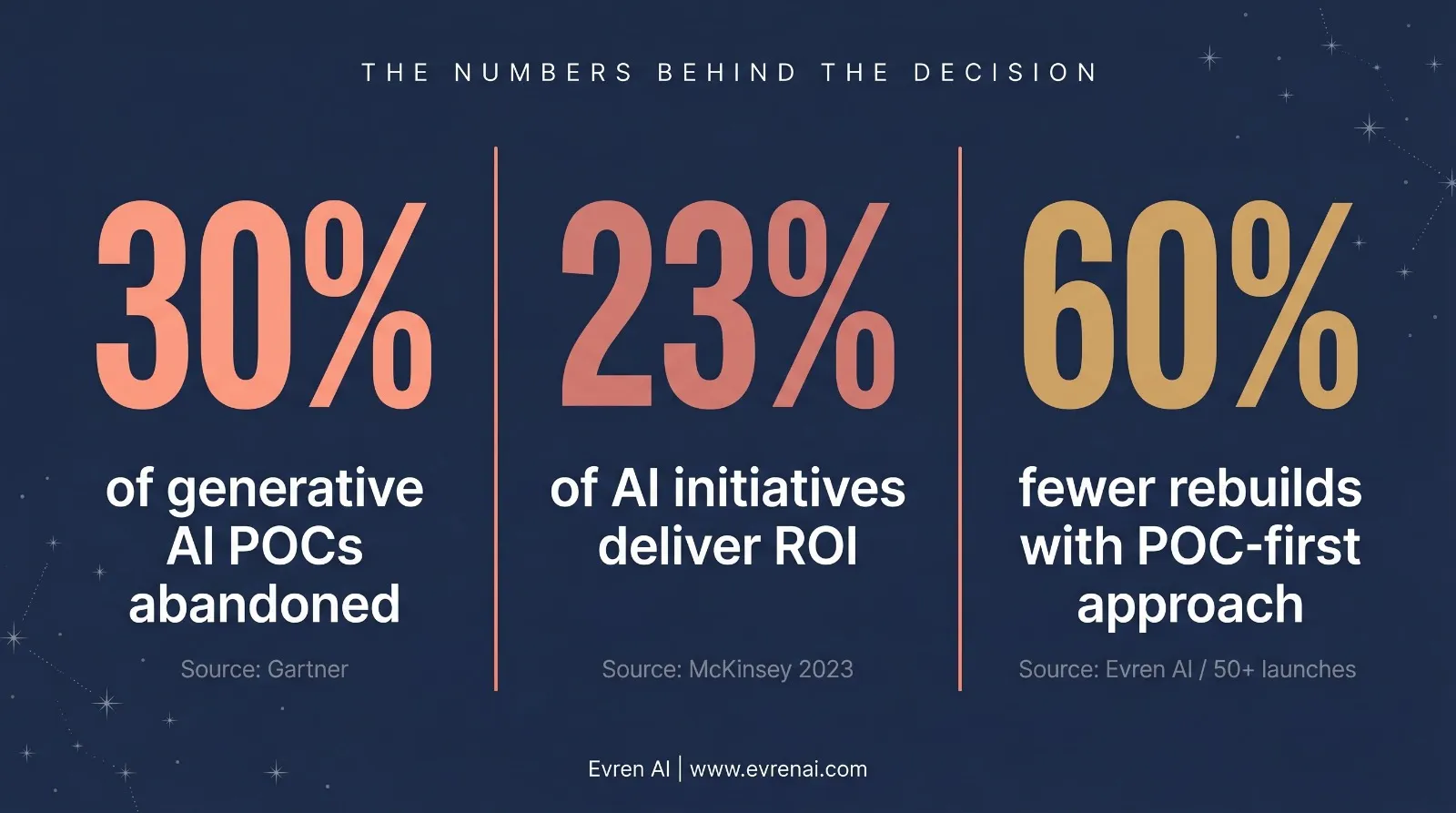
Our analysis of 50+ AI product launches shows teams that run a focused POC before MVP reduce rebuild rates by 60%. That's not philosophy. It's a repeatable pattern.
What Most Guides Don't Tell You
Not every AI product needs a large language model. And not every LLM use case needs a POC. Here's the honest version: if you're integrating Claude or GPT-4 via API for a well-understood task (summarisation, classification, drafting), you probably don't need six weeks of POC. You need a strong discovery sprint and a well-scoped MVP.
A fintech team we worked with in London skipped a formal POC because their use case (AI-generated quarterly summaries from structured financial data) had been proven by three similar products in the market. We moved straight to MVP. The product launched in 14 weeks.
The decision isn't about following a rule. It's about identifying your biggest risk and designing the shortest path to resolving it.
Frequently Asked Questions
Most AI products move from discovery to working MVP in 10-16 weeks when the use case is validated upfront and AI is integrated from sprint one. Skipping discovery typically adds 2-4 months of rework. A well-scoped AI product with clear success metrics can launch faster than most founders expect when architecture decisions are made early.
A focused AI POC typically costs $10K-30K depending on data complexity and scope. An MVP runs $50K-200K+ depending on features, compliance requirements like HIPAA or SOC 2, and whether AI infrastructure is built from scratch or integrated into existing systems. POC is cheap insurance before committing to MVP budget.
Not always. Many AI products, especially those using LLM integration with OpenAI GPT or Anthropic Claude via API, require minimal proprietary training data at launch. Data quality matters far more than volume. A discovery phase data audit identifies what you have, what you need, and what can be addressed through fine-tuning or prompt engineering.
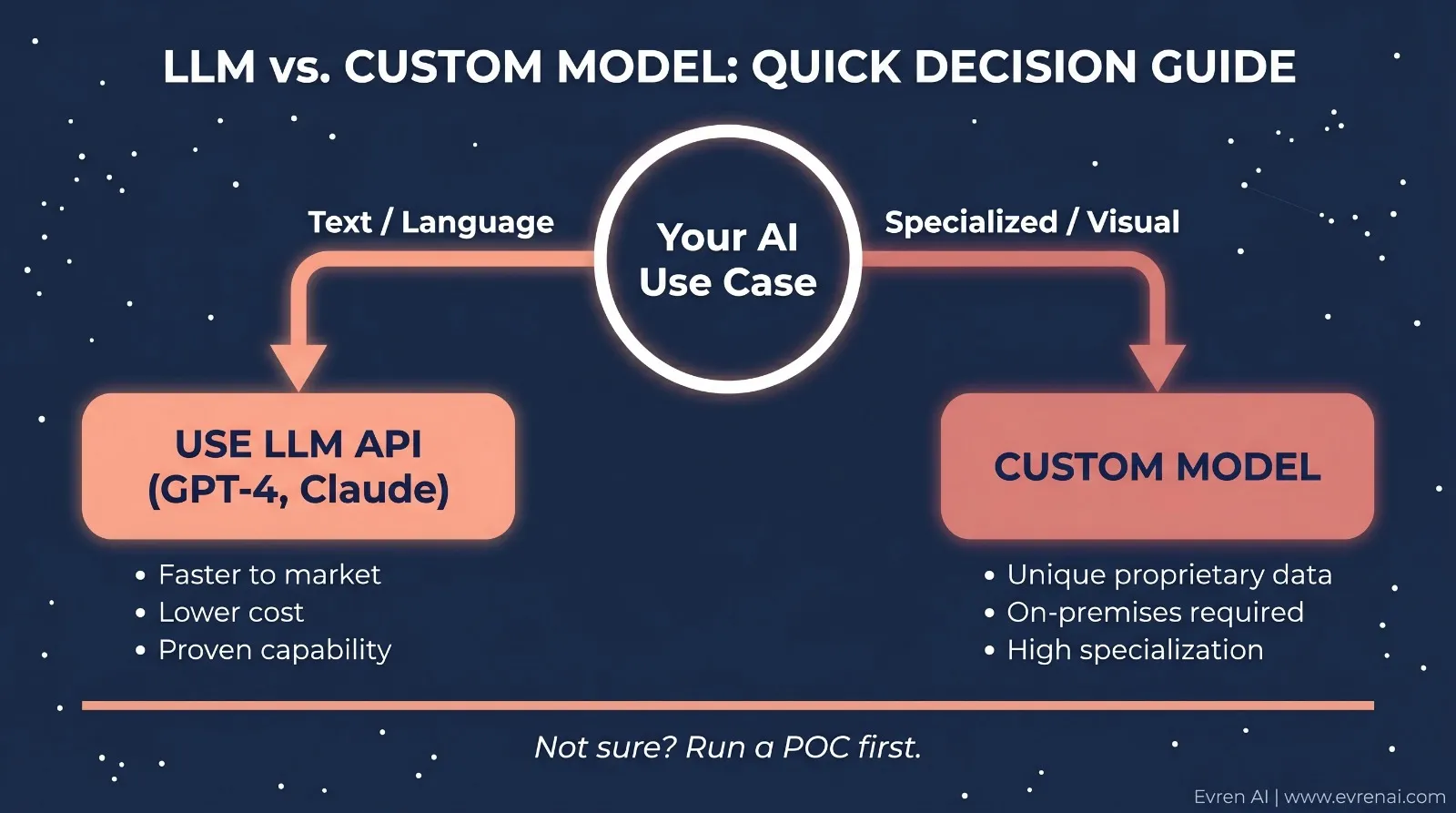
For most text-based use cases, GPT-4 or Anthropic Claude via API is the faster, cheaper, and more capable starting point. Custom model training makes sense for highly specialised domains, unique proprietary data, or compliance requirements like HIPAA mandating on-premises deployment. A discovery sprint clarifies which path fits your product before development begins.
They skip validation. Teams build before confirming the AI use case is solvable with available data, before defining measurable success metrics, before designing compliance into architecture. According to Gartner, 30% of generative AI projects are abandoned after proof of concept. The technology almost never fails. The strategy does.
At Evren AI, we partner with businesses of every size to build intelligent, human-centered digital products that solve real problems and create lasting value. Our success is measured by your independence: when we hand a product over, your team can own it, evolve it, and grow it without needing to call us back. If you have an AI idea and want to know whether to start with a POC or MVP, let's talk.