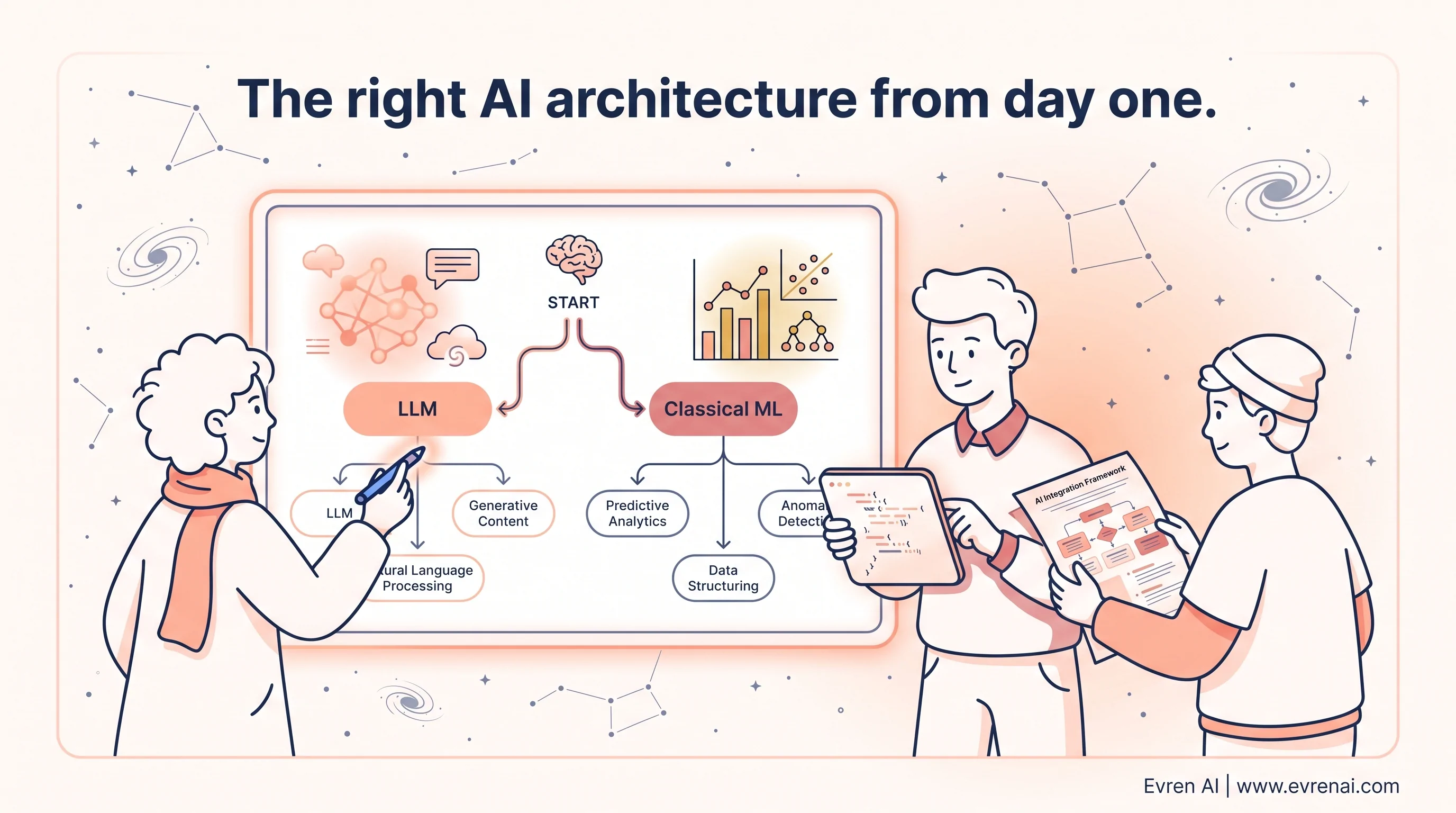
Most companies add AI to their product after launch. They build the product, ship it, and then someone asks in Q3: "Can we add an AI feature?" That question costs six months and two architecture rewrites.
AI embedded into the product development lifecycle from phase one is not the same product. It is a fundamentally different product, built faster, with fewer defects, better adoption, and a foundation for scale that compounds over time. The difference is not incremental. It is structural.
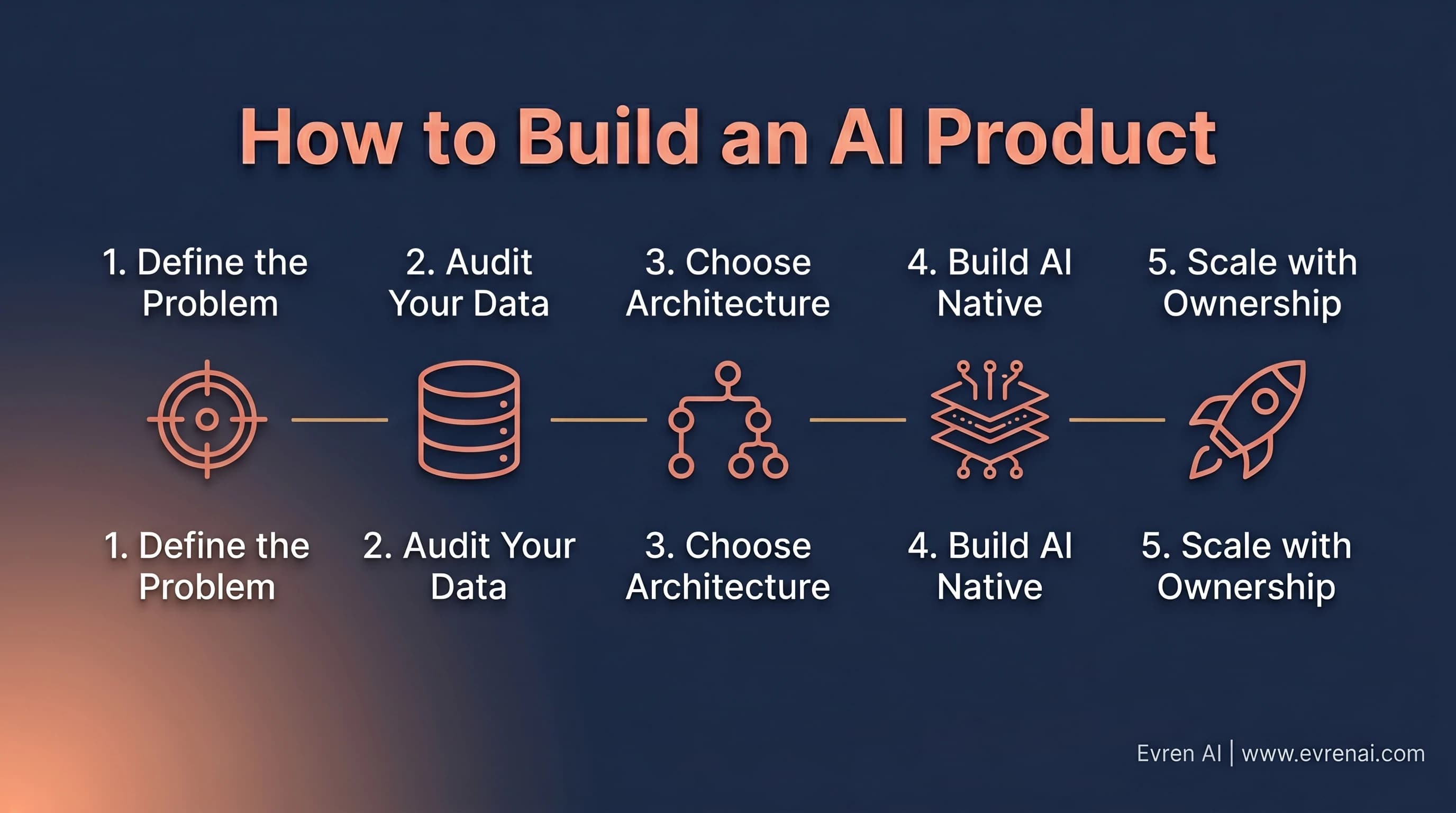
Here is what changes at each of the five lifecycle phases when AI is part of the process from day one.
What Role Does AI Play in the Product Development Lifecycle?
AI transforms every phase of the product development lifecycle: in discovery it surfaces user patterns your team would miss; in design it stress-tests architecture before a line of code is written; in development it catches defects earlier; in launch it predicts where users drop off; and in scale it keeps the product improving without proportional headcount growth.
Phase 1: Discovery and Planning
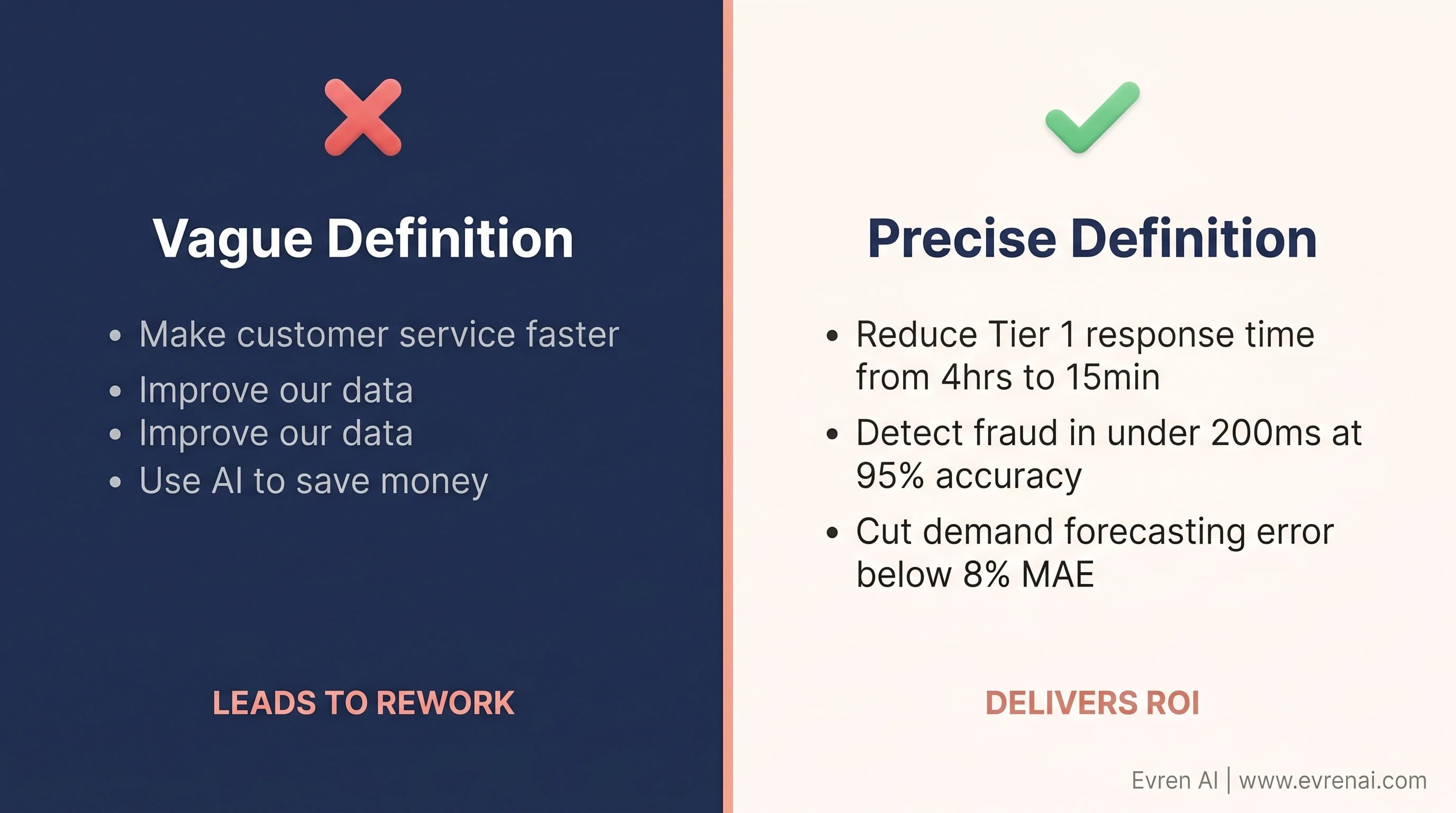
Discovery is where most AI products fail before they start. Not because the idea is bad. Because teams skip the two questions that determine everything: what exact decision will AI improve, measured as a number? And what does the data actually look like before anyone writes a line of code?
AI changes discovery by making pattern recognition faster. A Singapore-based e-commerce company we worked with had 14 months of unstructured customer feedback across three channels. Without AI-assisted synthesis, that analysis would take six weeks. With a Claude-powered processing pipeline using Python and LangChain, it took four days. See our generative AI capabilities.
Define your AI use case before defining your product architecture. The question is not "what can we build?" The question is "what exact decision will AI improve, and what does better look like as a number you can track from week one?"
Phase 2: Design and Architecture
Design is where AI-native products diverge from products that get AI bolted on later. When AI shapes the design phase, the data model reflects AI requirements from the start. UX is designed around AI outputs, not retrofitted around them. API structure accounts for inference latency and probabilistic responses from the beginning.
We have seen teams add five months to launch timelines because their frontend was designed for deterministic logic and AI introduced probabilistic outputs. The interface needed a complete rethink. That five months was not a development problem. It was a design problem that should have been solved in wireframes.
AI is not a feature we add at the end. It is woven into our thinking from day one. AI-native design means asking in Figma: how does this screen behave when the model is 94% confident versus 61%? Those questions belong in wireframes, not in the post-launch bug queue. See how we approach product architecture.
Phase 3: Development and Testing
AI changes development in two ways. The first is familiar: AI-assisted coding tools reduce boilerplate and surface syntax errors faster. The second is less obvious, and more important: AI models require fundamentally different testing protocols than deterministic code.
Unit tests pass or fail. AI outputs are evaluated. That distinction reshapes your QA process entirely. For LLM-powered features using OpenAI GPT-4 or Anthropic Claude via API, evaluation frameworks replace traditional test suites. You write test sets that measure accuracy, relevance, and safety, not just "does this function return the expected value." Not every AI product needs a custom model, but every AI product needs an evaluation strategy from sprint one. Explore our AI model evaluation approach.
According to McKinsey's 2024 State of AI Report, teams that integrate AI testing protocols from the first sprint reduce post-launch defects related to AI behavior by 40% compared to teams that test AI features in isolation at the end of the project. Think of your evaluation suite as orbital trajectory calculations. You program the flight path at launch, not mid-transit.
Phase 4: Launch and Iteration
Most products launch and measure what happened. AI-native products launch and predict what will happen next. Technology serves people. That principle shapes everything about how we design the launch phase, starting with who sees what and when.
At launch, AI changes three things: onboarding (AI personalizes the first-run experience based on early input signals), feature adoption (AI surfaces the right capability to the right user at the right moment), and support (AI handles Tier 1 questions before they reach a human agent).
A Houston-based fintech platform we launched used Python and AWS to instrument the onboarding flow with a real-time recommendation engine that adapted to user behavior from day one. Within 60 days of launch, Tier 1 support volume dropped 38%. That is not a feature. That is a different product entirely. See client outcomes.
Phase 5: Scale and Optimization
Scale is where AI-native products create compounding advantages over products where AI was retrofitted. Every user interaction becomes training signal. Every model update improves outcomes without new code. Every new data source amplifies what the product already does well.
Our success is measured by your independence. When we complete a product engagement, your team should be able to run model updates, evaluate new data sources, and push improvements without calling us back. That means AI infrastructure that is documented, observable, and owned by your team from day one, built into every phase of the lifecycle, not handed over at the finish line.
According to Gartner's 2024 AI investment analysis, AI-native products see a 2.3x improvement in feature velocity in year two versus year one, as training data accumulates and models sharpen on real usage. Products where AI was retrofitted see no equivalent compounding effect. That gap grows every year. It starts in phase one.
YOU HAVE THE VISION. WE HAVE THE TEAM.
Book a free 30-minute discovery call and tell us what you are building.
Here Is the Bottom Line
AI in the product development lifecycle is not about adding intelligence to an existing process. It is about redesigning the process around intelligence from the start. Discovery becomes more precise. Architecture becomes more resilient. Testing becomes more meaningful. Launch becomes more personal. Scale becomes compounding.
At Evren AI, we partner with teams of every size to build intelligent, human-centered digital products that solve real problems and create lasting value. Our success is measured by your independence: when we hand a product over, your team can own it, evolve it, and grow it without needing us in the room.
Ready to build something intelligent? Start here.
Have an idea? Let us talk.
Book a free consultation. Tell us what you are building and we will tell you honestly if we are the right team to build it with you.
Book a Free ConsultationFrequently Asked Questions
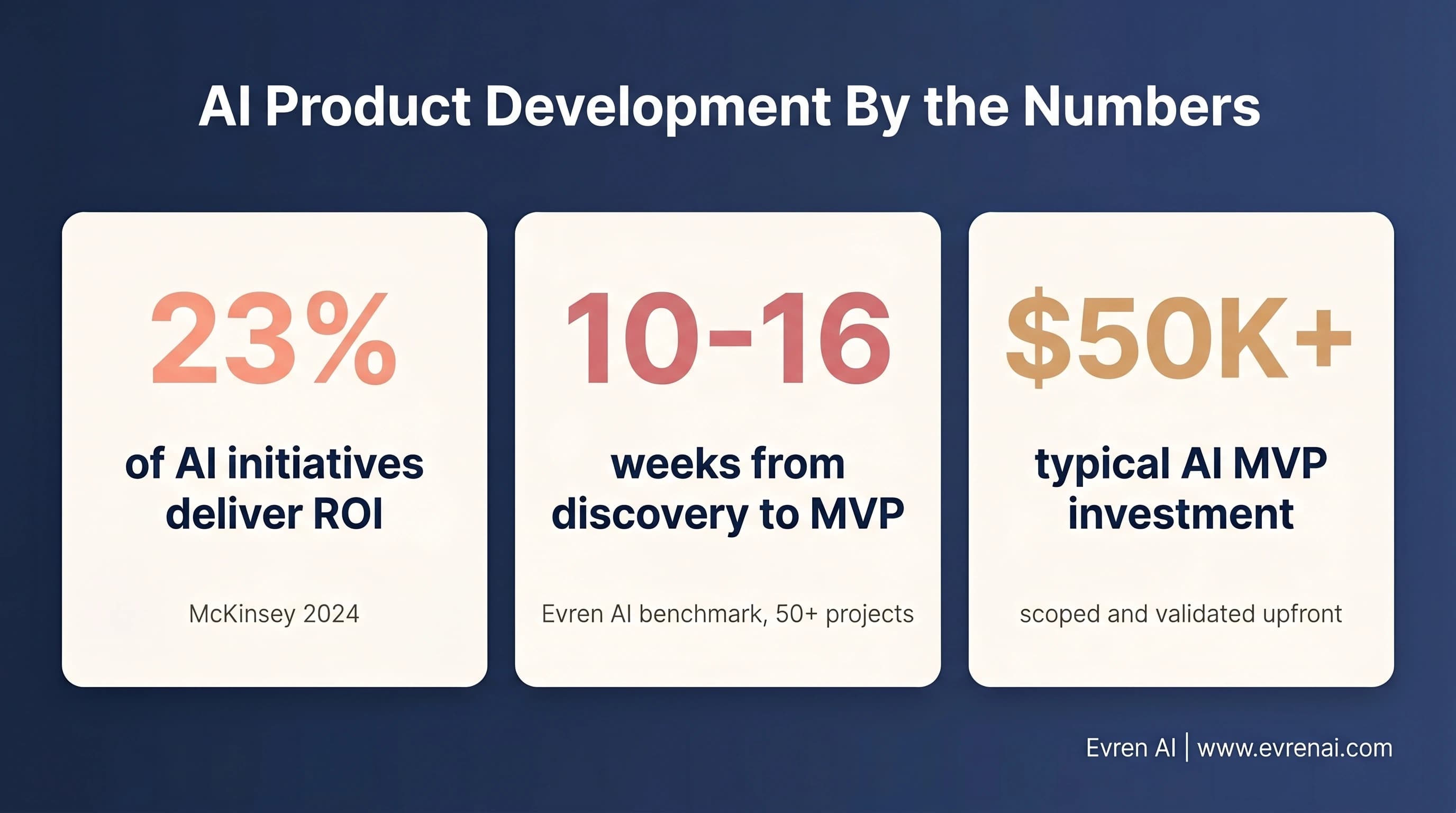
AI-native products move from discovery to working MVP in 10 to 16 weeks. Products where AI is added post-launch typically require two to four months of architectural rework that could have been avoided. The upfront investment in AI-native architecture pays back immediately in reduced rework cycles, faster iteration, and a product that compounds in capability rather than accumulating technical debt over time.
Not at the start. Most MVPs use LLM APIs like OpenAI GPT-4 or Anthropic Claude, which require minimal data science expertise to integrate via API. Data scientists become necessary when you move to custom model training or accumulate enough proprietary data to fine-tune for your domain. A two-week discovery sprint clarifies exactly when that threshold applies to your specific product and data situation.
Retrofitting architecture. Teams add AI to a product designed for deterministic logic. The data model was never designed for AI inputs. The UX was never designed for probabilistic outputs. The API was never designed for inference latency. Result: two to four months of rework that a proper AI-native discovery phase would have prevented entirely. Every time. Not sometimes.
Both are strong starting points for text-based product features. Anthropic Claude performs well for structured outputs, document analysis, and tasks requiring consistent output format. GPT-4 is strong for code generation and multi-step reasoning. The right choice depends on your specific use case, data privacy requirements, and cost profile. A discovery sprint with a data audit determines the right model before any development budget is committed.
Define AI success metrics in phase one. Use accuracy and precision for classification tasks, BLEU or ROUGE for generation tasks, and business KPIs like support deflection or conversion lift for product outcomes. According to Gartner, 30% of AI POCs are abandoned because success was never defined upfront. That failure starts at phase one and compounds through every subsequent phase.