You have an AI idea. You have budget. You have a timeline. What you might not have is a clear answer to three questions: What exact decision will AI improve? What does success look like in a number you can measure? And what does it cost if the AI gets it wrong?
Most AI products fail before a single line of code is written. Not because the technology does not work. Because teams skip the thinking that determines whether it should be built at all.
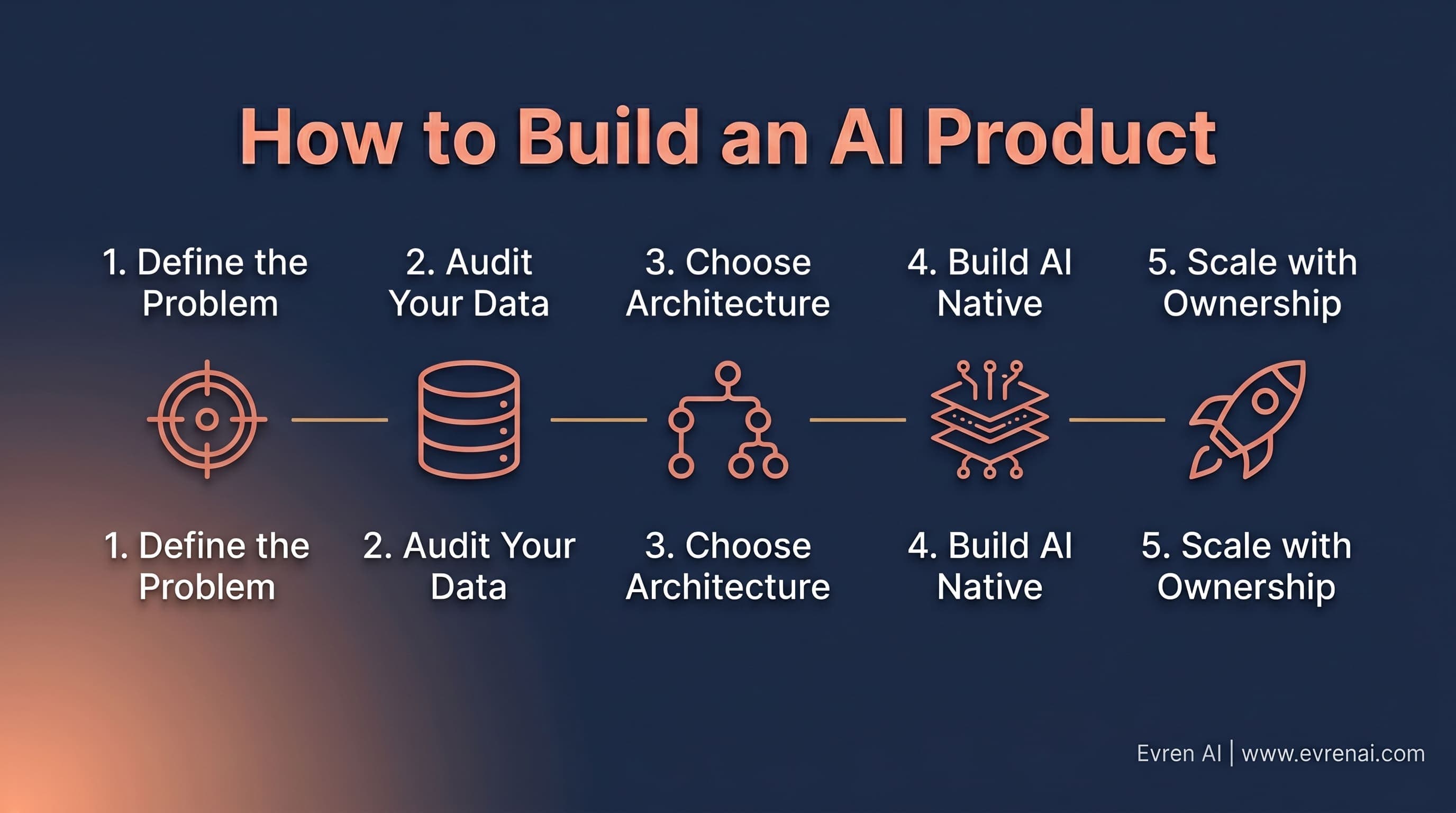
Here is the five-step process we use at Evren AI across 50+ AI products delivered, to go from idea to working, intelligent product.
What Does It Take to Build an AI Product?
Building an AI product requires aligning four things before touching a line of code: a precisely defined problem, measurable success criteria, validated data, and an architecture that places intelligence at the foundation rather than bolting it on later. Skip any one of these and you will rebuild. Most teams do.
Step 1: Define the Problem With Precision
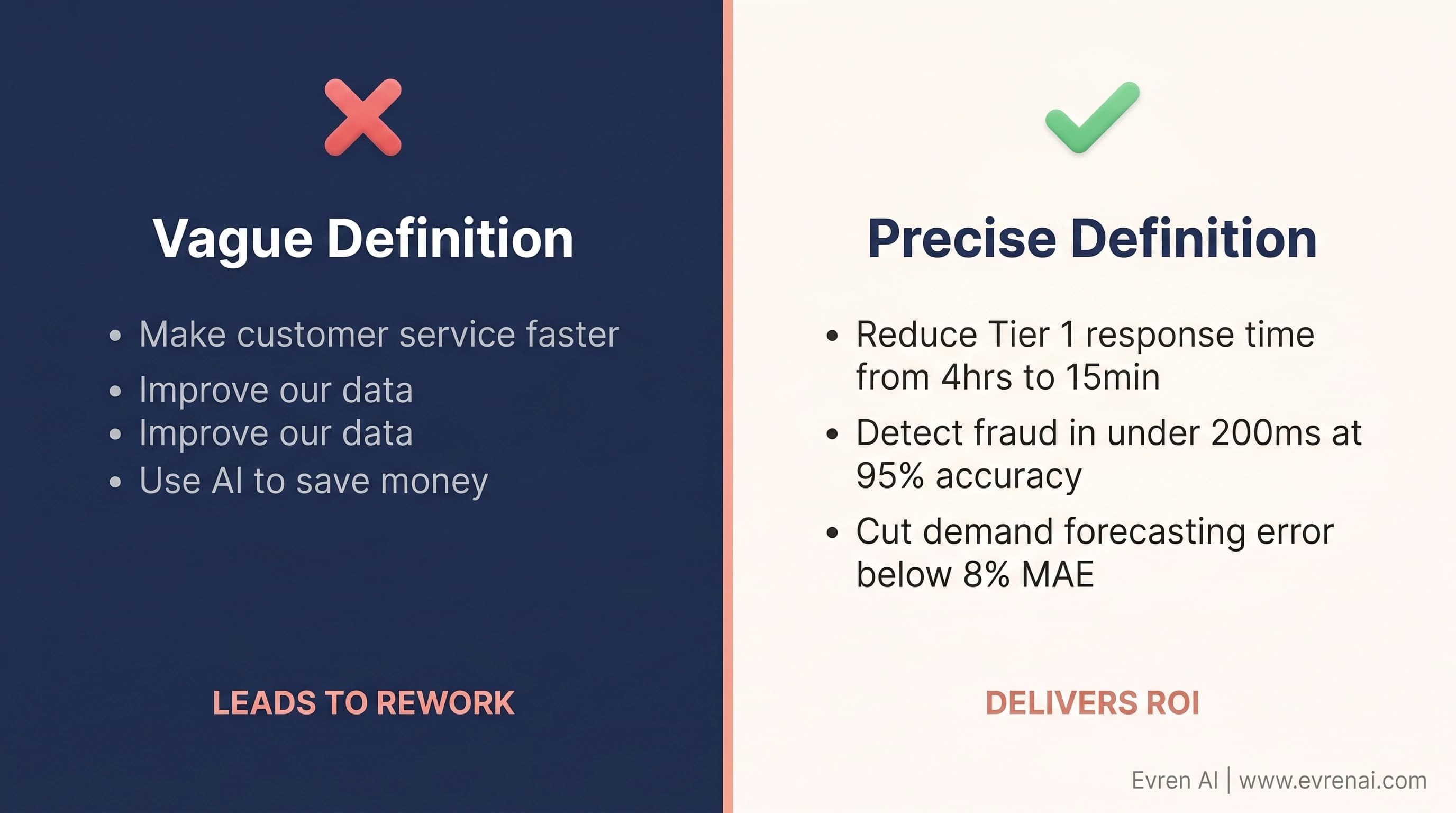
Start with a question that sounds simple but almost no one answers honestly. What exact decision or task will AI improve, and what does "better" look like as a number?
"Faster customer service" is not a problem definition. "Reduce first-response time from four hours to under 15 minutes for Tier 1 support tickets" is. If your answer is vague, you are not ready to build.
We have seen teams invest six months building before discovering their use case was solvable with a spreadsheet. That is not a technology failure. It is a scoping failure, and it happens before the first sprint. See how we run product discovery.
Step 2: Audit Your Data Before You Build
AI needs data. More specifically, AI needs the right data, in usable condition, with sufficient volume for the use case.
Here is what most guides do not tell you: data quality matters far more than data quantity. A Houston-based logistics company we worked with had 18 months of shipment records in three different formats across two legacy systems. The AI architecture worked. The data integration took twice as long as expected.
Do a data audit in discovery. Answer: What data exists? What is its quality? What is missing? Can it be anonymized for compliance under HIPAA or SOC 2 if required? A two-week data audit in the Discover phase prevents a four-month delay during Build.
Step 3: Choose Your AI Architecture Based on the Problem
This is where most teams make the costliest mistake. They choose a technology first and then design the product around it. Design the product first and let the problem determine the technology.
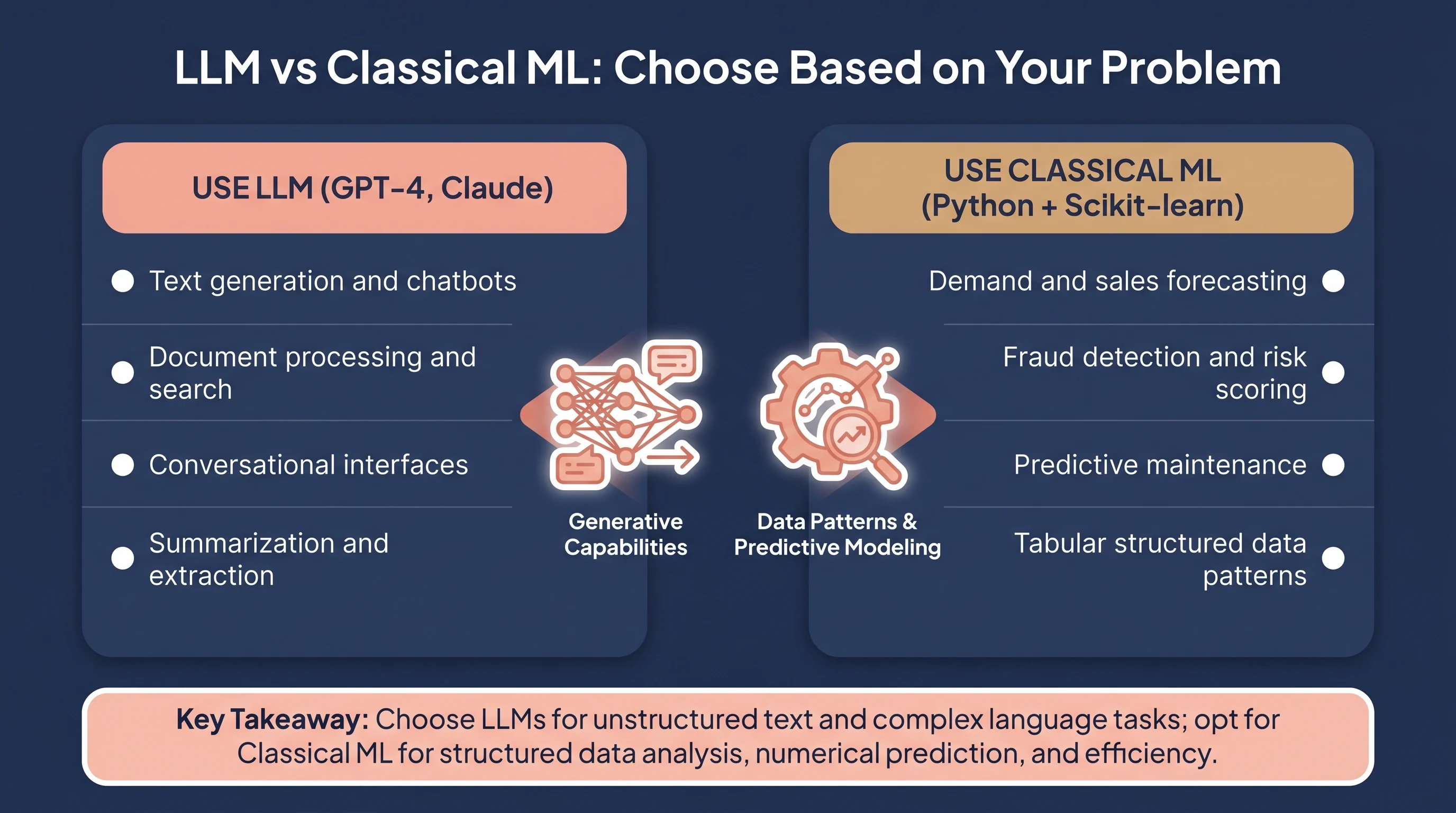
For text-based products including chatbots, document processing, and intelligent search, LLM integration using OpenAI GPT-4 or Anthropic Claude is typically the fastest, most capable starting point. You do not need to train a model from scratch for most text use cases.
For structured data problems including demand forecasting, fraud detection, and predictive maintenance, classical machine learning with Python and Scikit-learn often outperforms deep learning at a fraction of the cost. See our machine learning approach.
Think of architecture selection like choosing an orbital trajectory. Get the angle right at launch and you expend almost no fuel staying on course. Choose wrong and every correction costs exponentially more. Not every AI product needs a large language model. Knowing the difference saves months.
Step 4: Build With AI Native, Not AI Retrofitted
This is the principle that separates AI products that deliver ROI from those that do not.
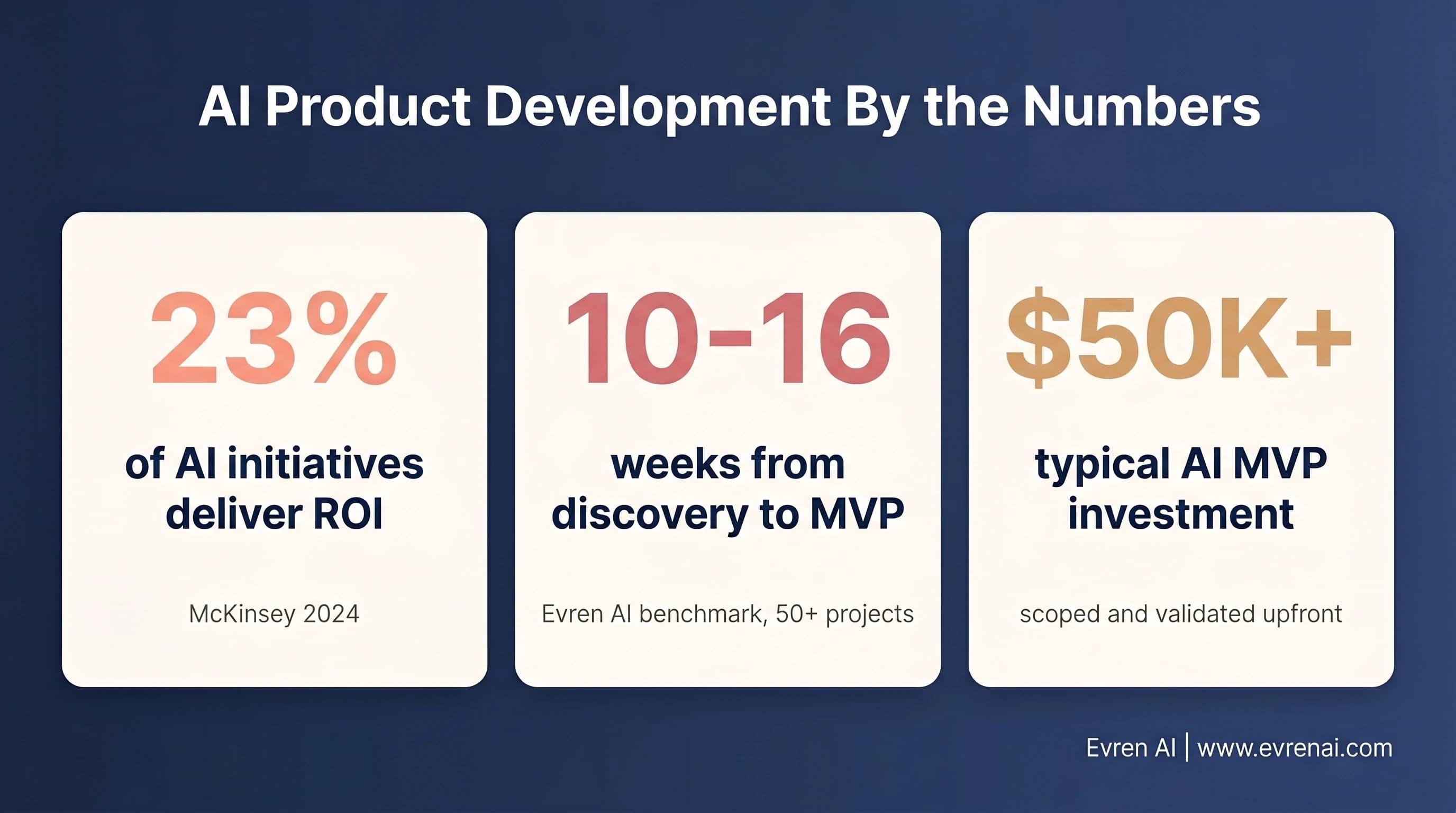
When AI is designed into the product from the first sprint, it shapes the data model, the UX, the API structure, and the backend architecture. When it is added later, it fights every decision that came before it. According to McKinsey's 2024 State of AI Report, only 23% of AI initiatives deliver meaningful ROI. The products that succeed are almost always those where AI requirements were part of architecture from day one.
AI is not a feature we add at the end. It is woven into our thinking from day one. Every sprint begins with AI requirements alongside feature requirements. See our AI agent development.
That is not a philosophy. It is the difference between a product that works and one that spends its entire life fighting its own architecture.
Step 5: Scale With Your Team's Ownership in Mind
A product that launches and cannot be maintained by your team is a liability, not an asset.
Model performance degrades when production data drifts from training data. User behavior evolves. Business requirements change. Your team needs to own those changes without calling anyone back.
Our success is measured by your independence. When we complete an engagement, your team should own, evolve, and operate the product without calling us back. That means knowledge transfer sessions, technical documentation, runbooks, and capability development built into every project from the beginning.
A Singapore-based e-commerce company we worked with launched a recommendation engine trained on 2 million product interactions using Python and AWS SageMaker. Their internal team was running independent model updates within 90 days of launch. That is the goal. Not dependency. Independence. See client outcomes.
YOU HAVE THE VISION. WE HAVE THE TEAM.
Book a free 30-minute discovery call and tell us what you are building.
Here Is the Bottom Line
Building an AI product is not complicated. But it requires doing the hard thinking before the first line of code: define the problem precisely, audit your data, choose architecture based on the problem and not the hype, build with AI native from sprint one, and plan for your team's independence before you launch.
At Evren AI, we partner with businesses of every size to build intelligent, human-centered digital products that solve real problems and create lasting value. When we hand a product over, your team can own it, evolve it, and grow it without needing us in the room.
Ready to build something intelligent? Start here.
Have an idea? Let us talk.
Book a free consultation. Tell us what you are building and we will tell you honestly if we are the right team to build it with you.
Book a Free ConsultationFrequently Asked Questions
Most AI products move from discovery to working MVP in 10 to 16 weeks when the use case is validated upfront and AI is integrated from sprint one. Skipping discovery typically adds two to four months of rework. A well-scoped AI product with a clear success metric can launch faster than founders expect when architecture decisions are made early.
AI product development ranges from $50K for a focused, well-defined MVP to $200K or more for enterprise platforms with complex AI architecture. Main cost drivers are scope, data quality and complexity, compliance requirements like HIPAA or SOC 2, and whether AI infrastructure is built from scratch or integrated into existing systems.
Not always. Many AI products, especially those using LLM integration with OpenAI GPT-4 or Anthropic Claude via API, require minimal proprietary training data at launch. Data quality matters far more than volume for most use cases. A discovery phase data audit identifies what you have, what you need, and what can be addressed through fine-tuning or prompt engineering.
For most text-based use cases, GPT-4 or Anthropic Claude via API is the faster, cheaper, and more capable starting point. Custom model training makes sense with highly specialized domains, unique proprietary data, or compliance requirements mandating on-premises deployment. A discovery sprint determines which path fits your specific product before development begins.
They skip discovery. Teams build before confirming the AI use case is solvable with available data, before defining measurable success metrics, and before designing compliance into architecture. According to Gartner, 30% of generative AI projects are abandoned after proof of concept. The technology almost never fails. The strategy does.