
From Our R&D Lab to Published Research: Setting a New Benchmark in AI-Powered Human Analysis
Standard Human Activity Recognition (HAR) systems face significant limitations in accuracy and adaptability. To solve this, our internal R&D team embarked on a project to push the boundaries of the field. The result was a novel two-stream deep learning architecture that fuses visual (RGB) and skeletal data, culminating in peer-reviewed research published in the acclaimed journal, Sensors. This work establishes a new state-of-the-art for understanding human actions with unparalleled nuance.
Deep Tech / Applied Research & Development
Overcoming State-of-the-Art Limitations in HAR
Novel Two-Stream Network, Multimodal Fusion, (2+1)D CNNs
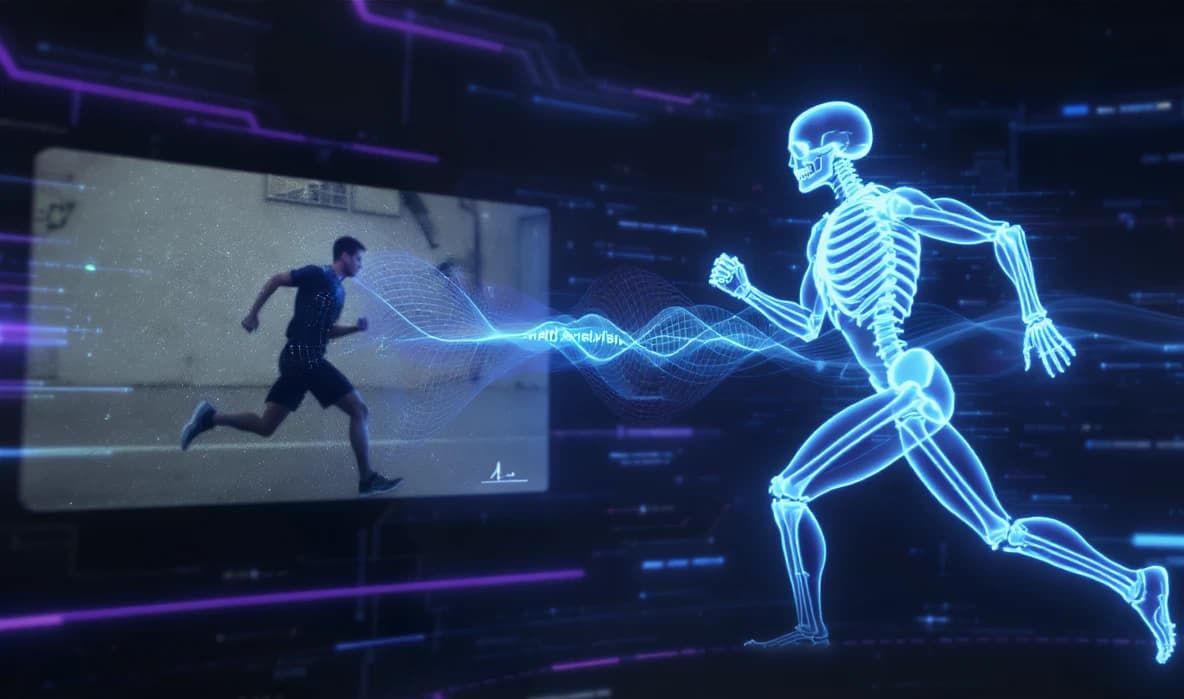
The Strategic Imperative: Achieve Superior Accuracy by Fusing Multimodal Data
Overcoming the Weaknesses of Single-Data Systems
The challenge was to combine RGB video and skeletal data, leveraging both to create a more robust and accurate representation of human activity.
Efficiently Processing Spatiotemporal Video Data
We needed an efficient method to process video data, capturing spatial features and temporal evolution without the high computational cost of traditional 3D-CNNs.
Extracting Meaningful Patterns from Skeletal Data
The objective was to develop an LSTM network capable of understanding complex temporal dynamics in skeletal data, using features like joint angles and distances.
What a Technology Partner Had to Say
Arthur Raymond ScottChief AI OfficerFortune 500 Technology Partner
“In today's market, true innovation requires a partner who operates at the bleeding edge. Evren AI's published research in Human Activity Recognition is a testament to their deep technical expertise. It is this commitment to fundamental R&D that gives us the confidence to partner with them on our most ambitious and complex AI initiatives.”
Our Blueprint for a State-of-the-Art Recognition Engine
Designed a Novel Two-Stream Fused Architecture
Engineered a dual-pathway network, using (2+1)D CNN for RGB video and Bidirectional LSTM for skeletal data to capture motion dynamics.
Implemented Advanced Feature Engineering & Selection
Engineered features based on distances and angles between 17 keypoints, and used Forward Feature Selection to enhance model efficiency and accuracy.
Developed a Probabilistic Fusion Mechanism
Combined outputs from both streams using fusion techniques, improving prediction accuracy and reliability over individual streams.
Rigorously Validated Against Academic Benchmarks
The model was tested on the UTD-MHAD dataset, surpassing existing state-of-the-art methods in academic benchmarking.
The Transformational Outcome:A New Performance Benchmark and a Foundation for Innovation
Achieved 98.94% Recognition Accuracy on the UTD-MHAD Benchmark
Our two-stream architecture reached 98.94% accuracy on the UTD-MHAD benchmark, surpassing previous state-of-the-art models.
Authored a Peer-Reviewed Publication in Sensors
The novelty of our methodology was validated by the publication of our research in a prestigious, international peer-reviewed journal.
Created a Reusable Framework for Future Applications
The R&D effort produced a robust framework that Evren AI can now use to address real-world challenges in various industries.
Cemented Evren AI as a Leader in Applied AI Research
This project highlights our commitment to advancing AI and solving industry challenges, solidifying Evren AI's leadership in applied research.
Published Research
Rehman, S. U., Yasin, A. U., Ul Haq, E., Ali, M., Kim, J., & Mehmood, A. (2024). Enhancing Human Activity Recognition through Integrated Multimodal Analysis: A Focus on RGB Imaging, Skeletal Tracking, and Pose Estimation. Sensors, 24(14), 4646 · MDPI. DOI: 10.3390/s24144646